

 Copy to clipboard
Surgical robots are evolving into near-essential technologies for orthopedic companies that want to compete at the top of the joint replacement and spine markets. At Rowan University, work is underway to bring the same level of high-tech solutions to trauma care.
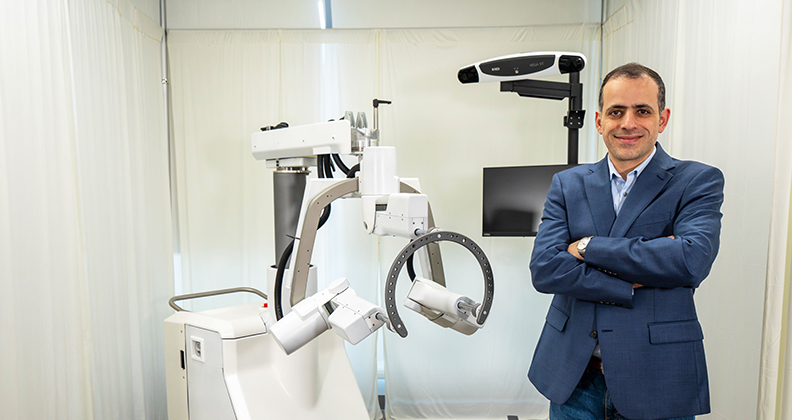
Mohammad Abedin-Nasab, Ph.D., Associate Professor of Biomedical Engineering at Rowan, and a team of researchers have developed Robossis, an advanced prototype of the world’s first robotic surgical system that’s designed for the minimally invasive alignment of fractured long bones.
The germ of the idea hit Dr. Abedin-Nasab early in his engineering career, when he observed a two-year-old boy undergoing surgery to repair a broken femur. The patient lost one liter of blood and suffered numerous complications.
That experience inspired Dr. Abedin-Nasab to develop a solution for what he calls a “huge clinical need,” especially among vulnerable patient populations. He also noted that up to 28% of all long-bone fractures don’t heal correctly because it’s difficult for surgeons to align the separate bone segments.
Dr. Abedin-Nasab said his team knew that the robot they created needed to easily manipulate bone fragments, provide enough force to move the largest muscles in the body that sit around the femur, making it difficult for surgeons to access the bone, and operate within the tight spatial limitations of a trauma operating room — all while being compatible with standard equipment like fluoroscopy and surgical tables.
Robossis addresses those requirements with a unique arm placement that creates a large surgical workspace, 2,000 Newton force capabilities that are more than 10 times higher than current surgical robots, bone tracking with submillimeter accuracy and AI-driven intraoperative guidance for optimal bone positioning. It’s a three-arm parallel robot that attaches quickly to bone and works in six degrees of freedom to precisely align, stabilize and reduce fractures, allowing surgeons to apply their chosen fixation method.
“The bone gripping and attachment approach is especially important because it localizes manipulation of the distal fragment while maintaining stability and reducing the risk of overshoot and unnecessary soft-tissue stress,” Dr. Abedin-Nasab said.
The combination of strong insertion force and compact footprint represents key elements of the robot’s patented design, which Dr. Abedin-Nasab said improves a surgeon’s ability to assess and execute bone alignment in a controlled way rather than using repeated trial-and-error manual attempts.
During those attempts, trauma surgeons often rely on brute strength, visual estimation and repeated imaging to ensure bones are set as accurately as possible, making the repair of long bone fractures one of the most physically demanding procedures in orthopedics.
Robossis was designed to reduce the procedure’s variability and physical strain. Its features also reduce the physical burden of performing bone traction and manipulation, support more reproducible reductions and streamline procedures by integrating navigation and alignment feedback directly into the procedure.
Equally important was ensuring that the robot fits seamlessly into clinical workflows and feels natural for trauma surgeons to use.
Dr. Abedin-Nasab’s team met those goals with the development of a platform with intuitive surgeon controls and a haptic interface. That real-world usability could be why Robossis shows promise for commercialization success when other attempts at developing a robot for fracture repair have struggled to reach the finish line.
The platform’s compact design also positions it for the ongoing migration of procedures to ASCs, where O.R. space is at a premium and teams thrive on surgical efficiencies.
“Many earlier efforts were not designed around the real-world constraints of trauma surgery,” Dr. Abedin-Nasab said. “The key advantage of our design is that it was built for practicality in terms of surgeon access, imaging compatibility and workflow integration, not just kinematics.”
Fracture surgery remains an analog procedure, with surgeons relying on many of the same tools and techniques they’ve used for decades. They perform manual fracture reductions and often employ imprecise alignment approaches, which can lead to longer operative times and a high incidence of limb malalignment.
While specialties like joint replacement and spine surgeons have embraced enabling technologies, trauma has remained mostly a manual pursuit. “Orthopedics is moving toward data-guided, reproducible workflows,” Dr. Abedin-Nasab said. “Robossis helps bring that level of precision, repeatability and workflow intelligence to trauma cases.”
The system helps surgeons achieve optimal bone alignment to prevent numerous complications — including chronic pain, impaired mobility, repeat surgeries and prolonged recovery — and reducing the need for repeated fluoroscopic imaging.
“Trauma surgeons deserve the same high level of enabling technology support that other orthopedic specialties have begun to adopt,” Dr. Abedin-Nasab said. “Being first in the development of a fracture repair robot is a chance to set the standard for how trauma procedures can become more precise, less variable and more data driven.”
The Robossis project is backed by a wide range of collaborators, including the National Institutes of Health, the National Science Foundation and the New Jersey Commission on Science, Innovation and Technology.
As the robot nears clinical use, Dr. Abedin-Nasab’s team is currently working on preclinical validation and preparing for regulatory approval with the goal of moving toward clinical studies and engaging with FDA. “We want to do that with the right evidence package in hand rather than rushing the process,” he said