

 Copy to clipboard
Timothy W. Simpson, Ph.D., remembers when additive manufacturing was more novelty than mainstream. About 15 years ago, he recalls blowing through his entire materials budget after buying titanium powder for the first of six planned builds. Thankfully, materials and printing platforms are now less expensive and build times continue to decrease, making additive manufacturing a much more practical option for device development.
Dr. Simpson, Fellow ADDVisor at The Barnes Global Advisors and a professor emeritus at Penn State, is an additive manufacturing expert who has worked across several industries to optimize engineering designs. He knows all too well what it takes to introduce new products in a highly competitive market like orthopedics.
“Nobody wants to be first, but nobody wants to be third, either,” he said. “It takes one company to break the mold, and then everyone else follows.”
Breaking that mold can prove challenging. Questions remain about ways to optimize additive’s applications as orthopedic companies navigate a landscape filled with enticing potential but also several hurdles to clear before unlocking all that 3D printing has to offer.
Stagnant Designs
Early adopters of additive manufacturing developed groundbreaking knee, hip and spinal implants. Companies that aren’t printing these types of devices by now find themselves playing catch-up to the competition.
“We’ve shifted from additive manufacturing being a new, exciting technology to it becoming a must-have capability in the industry,” Dr. Simpson said. “The technology itself is no longer the differentiator. It’s the design of the devices that sets companies apart.”
Today, the focus is on how to use additive manufacturing to create better implant designs that reduce the number of surgical steps and fixation points, while improving patient outcomes and shortening recovery times.
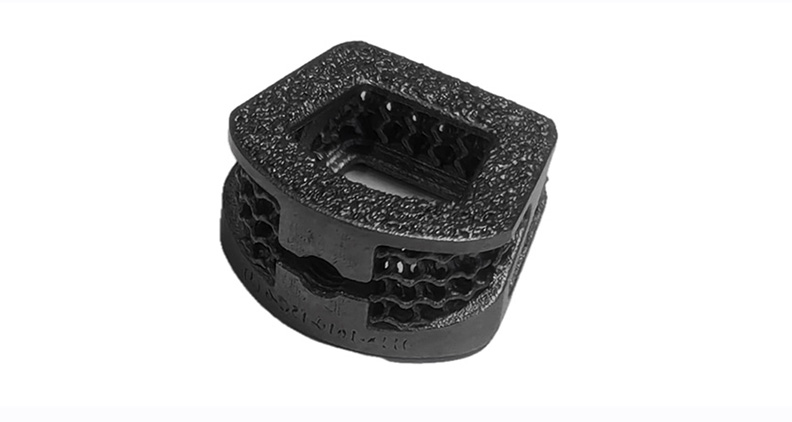
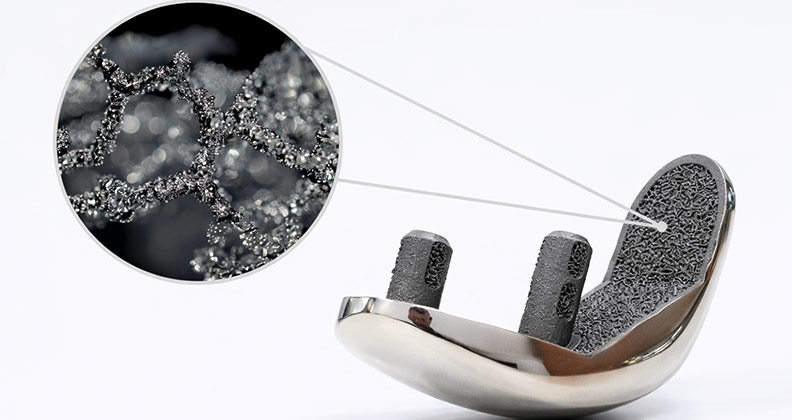
“The technology has become another powerful tool in the toolboxes of engineers and manufacturers,” said Jennifer Moore, Ph.D., founder of the engineering consulting firm Human Aided Design and a product development leader who led the integration of additive manufacturing at K2M. “For orthopedic implants, that means we’re no longer limited to simply adding surface roughness for fixation. We can design highly engineered porous architectures and bony ingrowth features that extend throughout portions of the implant, allowing us to better support biological fixation.”
Moore said additive manufacturing allows engineers to move beyond machining rectangular blocks to creating implants that fit naturally curved anatomy and better conform to a patient’s anatomy.
The greater emphasis that’s placed on designing patient-matched implants presents its own set of challenges. Companies that effectively capture and analyze large amounts of patient and population data will be positioned to translate those insights into better designs. In the near term, that might mean using available data to improve the standard sizes of today’s implants.
“If expanding from three size categories to five or six significantly improves patient fit and clinical outcomes, that’s a meaningful step toward personalization,” Dr. Simpson said.
Moving additive manufacturing forward requires the combination of three elements: manufacturing technology, advanced design capabilities and the software to bring them together. Dr. Simpson noted that It’s no longer enough to rely on traditional CAD alone.
“Today’s applications require far more sophisticated design tools,” he said, “and there are now a wide range of technologies available to support that.”
Regulatory Red Tape
One of the biggest challenges related to additive manufacturing continues to be the increasing regulatory burdens placed on product development and manufacturing teams.
Dr. Simpson benefits from the perspective of seeing how various industries have adopted additive manufacturing and believes medtech is leading the way in commercializing effective products. He pointed out that FDA was among the first regulatory agencies to provide guidance for 3D-printed implants and devices.
But that doesn’t mean the regulatory pathway is easily navigated. Dr. Simpson has led several device design workshops with medtech companies, during which engineers came up with several innovative ideas. Their excitement was short-lived, ending as soon as regulatory experts were brought in to assess what the teams had concocted.
“If a new design couldn’t be linked to a predicate device, the discussion often ended there,” Dr. Simpson said. “The design teams decided not to pursue it.”
He believes regulatory requirements are one of the major factors that are holding back innovation in orthopedics. Engineers can develop truly novel designs that have never existed before, but without a clear predicate, the regulatory pathway becomes muddled.
“At that point, companies must decide whether it’s worth making a significant investment to pursue a more complex approval process for what may only be an incremental improvement in performance,” Dr. Simpson said. “In many cases, they don’t.”
Patient safety should always remain the highest priority, but Moore called for greater harmonization among global regulatory bodies.
“Companies often find themselves demonstrating safety and effectiveness through multiple regulatory pathways that are similar in intent but different in execution,” she said. “Reducing unnecessary duplication while maintaining rigorous standards would allow engineering teams to spend more time advancing innovation and less time navigating administrative complexity.”
Moore said verifying that the manufactured part truly matches the intended CAD model becomes significantly more challenging as implant geometries become increasingly organic and porous. She added that advances in non-destructive inspection, in-process monitoring and digital verification provide manufacturers with greater confidence that every printed part consistently meets its design intent through verification and validation and into production.
“Improvements in quality assurance might have just as much of an impact on the future of additive manufacturing as improvements in printing technology,” Moore said.
Material Mix
Additive manufacturing makes it possible to functionally grade multiple materials within a single device, allowing engineers to design different mechanical or biological properties into various locations on an implant.
“We’re reaching the point where additive manufacturing no longer limits us to a standard catalog of materials,” Dr. Simpson said. “Instead, we can begin developing entirely new alloys tailored to specific applications.”
Additive manufacturing can create unique microstructures and distribute elements in ways that aren’t possible with subtractive manufacturing. The result is a material with properties that couldn’t be achieved any other way.
“Some materials perform better than others under different loading conditions,” Dr. Simpson said. “Custom designed alloys could be engineered to deliver improved strength, wear resistance, fatigue performance or biocompatibility.”
Moore is excited by the possibility of designing implants that better match the mechanical properties of bone. “Historically, we’ve implanted large blocks of metal into an organic, living system,” she said. “Through advancements in materials, porous architectures and additive manufacturing, we have an opportunity to better tailor implant stiffness, encourage healthy load transfer and create environments that promote long-term biological integration.”
According to Moore, design engineers should focus on creating implants that work more naturally with the body than traditional solid metal components.
“Instead of simply using additive manufacturing because we can, we’ll use it to engineer implants with region-specific architecture, stiffness and biological performance that better support healing while meeting the mechanical demands of the procedure,” she said. “The greatest breakthroughs won’t come from making more complicated parts. They’ll come from making implants that work more naturally with the human body.”
Production Limitations
The additive manufacturing industry is now entering a new phase of industrialization with a focus on making the technology more cost-effective through larger machines, improved processes and the rapid development of new printing platforms with a dozen or more lasers. Manufacturers are achieving higher productivity through faster build speeds and more efficient scan strategies.
Still, orthopedic companies are grappling with the most effective ways to scale production. Additive manufacturing is an iterative process that requires constant feedback between design and manufacturing.
Building additive manufacturing capabilities in-house requires greater upfront investment, but it allows you to develop process knowledge. That experience becomes a competitive advantage because every build deepens your understanding of how process parameters influence part quality and performance.
“If you can’t walk over to the machine, ask why a build failed, learn from the process engineer or technician, and then feed those insights back into the design, you’re at a disadvantage,” Dr. Simpson said. “You won’t be able to iterate nearly as quickly.”
The same theory applies if you partner with a contract manufacturer to produce parts you’ve sent in a design file. During the early learning and iteration stages, it’s essential to establish a close and collaborative relationship. Otherwise, you’ll receive the finished product without the valuable knowledge that comes from understanding why a build succeeded or failed.
Moving Forward
The orthopedic industry has spent much of the past decade learning how to print existing materials and manufacture parts more efficiently. The next step is asking what can be designed now that couldn’t be designed before.
“When we start creating entirely new materials, structures and functional features specifically enabled by additive manufacturing, that’s where boundaries will be pushed,” Dr. Simpson said. “We’re still at the tip of the iceberg of what’s possible.”