

 Copy to clipboard
Over the past several decades, robotic technology has transformed orthopedic surgery. What began as a high-tech solution focused on hip and knee replacements has evolved into a trusted tool for surgical precision, planning and consistency.
Today, as robotic systems extend into the demanding areas of spine and shoulder surgery, the goals of innovation are as much about improving the surgeon’s experience as they are about enhancing patient outcomes.
Orthopedic robotics has evolved from an idea of mechanical accuracy into a platform of digital intelligence. Robots are not replacing surgeons; they’re augmenting their abilities, helping to reduce fatigue, cognitive strain and variability while expanding what’s possible in the operating room.
For many surgeons, this is not only a shift in technology but also a transformation in how surgery is practiced.
The Evolution of Robotics
Ten years ago, orthopedic robotics were largely confined to specific, repetitive tasks, such as cutting bone or drilling holes for implants. Systems were complex, expensive and often dependent on manufacturer representatives in the operating room. Surgeons appreciated their promise of precision but found implementation to be cumbersome. The technology, though advanced, hadn’t yet met the realities of surgical workflow.
That has changed dramatically. Today’s orthopedic robots are more intuitive, data-connected and responsive to the needs of the surgical team. Preoperative planning software allows surgeons to digitally map procedures in advance, while intraoperative systems dynamically adapt to the patient’s anatomy in real time.
Integration with imaging and navigation tools now provides continuous visualization and positional accuracy within fractions of a millimeter.
The effect on surgeons has been profound. Instead of replacing human skill, robotics have extended it, making complex procedures more consistent, reducing surgeon fatigue and mitigating radiation exposure in fluoroscopy-heavy environments.
“We’re at the tip of the iceberg,” said Alessia Erlingher, Chief Commercial Officer at Spineart. “We’re seeing a development that will change the way in which spine surgery is performed. It will change the way in which surgeons are trained. It will change the way in which surgeons are thinking about the standard of care.”
Among orthopedic specialties, spine surgery has presented some of the greatest technical challenges for robotic integration. Early robotic systems focused on a single critical step: pedicle screw placement. Accuracy improved, but workflow remained fragmented.
Today, companies like LEM Surgical are reimagining what a spine robot can do.
“Right now, we’re in the early stages of robotic surgery,” said Christopher Prentice, Chief Commercial Officer at LEM Surgical. “We’ve overcome some of the arduous tasks. We’ve helped with the planning of the procedure and the intraoperative decision-making. Now you have a robot that serves as a data collection device.”
LEM Surgical’s Dynamis Robotic Surgical System, recently cleared by FDA for spinal procedures in the U.S., is a multi-arm platform designed to bring automation and precision to a broader range of tasks. With active navigation and open-architecture compatibility, Dynamis allows hospitals and surgeons to use their preferred implants and instruments rather than being restricted to specific sets.
More importantly, it represents a shift toward robotic systems that can assist in multiple stages of surgery.
“The team behind Dynamis is the same that originally developed the Mazor X with Mazor Robotics,” Prentice said. “We have over 15 years of hard tissue robotics experience, and we built that knowledge into Dynamis.”
The robots of today mainly focus on pedicle screw placement, Prentice explained, but there are key steps in spine surgery that still haven’t been addressed robotically, including bone removal, disc preparation, discectomy and osteotomy. The Dynamis system is designed to fill those gaps.
By targeting these overlooked yet physically demanding tasks, LEM aims to extend the benefits of robotics beyond precision to ergonomics and efficiency. The company’s goal is to help spine surgeons perform more of the operation robotically, minimizing both physical and cognitive strain without compromising human control of the procedure.
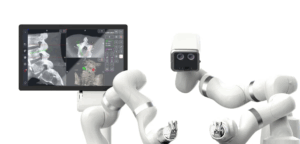
LEM Surgical’s Dynamis Robotic Surgical System enhances accuracy and control during spine surgeries.
Leveraging Data and Intelligence
The growing intelligence of surgical systems is now redefining the role of the surgeon. Navigation, imaging and data collection are converging to create a digital ecosystem where the robot serves as both a surgical assistant and a learning device.
At Spineart, this evolution is embodied in the Perla app, a digital interface that connects the company’s posterior fixation hardware with the eCential Robotics navigation platform. The app synchronizes hardware and software, turning what was once a static toolset into an integrated digital environment.
By digitally linking preoperative planning, intraoperative performance and postoperative outcomes, such systems create a closed data loop. Each procedure contributes to a growing body of knowledge that, over time, may enable predictive analytics, using machine learning to suggest optimal surgical plans based on outcomes data.
“Now, the entire patient journey is digitized,” said Laurent Node-Langlois, Chief Technology Officer at Spineart. “You know what was in the planning, you know exactly what was executed thanks to the robot and you have the follow-up information, which is also digital. So, this is a comprehensive loop that you’re building, and a loop is fantastic training material for machine learning.”
The goal is to reach a point where surgical outcomes can be predicted, Node-Langlois said.
LEM Surgical’s Prentice echoes that vision.
“With the type of data that’s collected, you’ll be able to compare and contrast surgical styles and approaches much better to determine the optimized process,” he said. “And as you add robotic or computer assistance, you may be able to proliferate an optimized approach or a proven outcomes data approach more readily because it reduces variability. You can then democratize outcomes across the board.”
The Surgeon’s Well-Being
Surgeons have long shouldered the physical toll of their profession. Long hours in lead aprons under x-ray guidance, repetitive motion and static posture all contribute to chronic back, neck and shoulder injuries. Robotics are emerging as a meaningful safeguard against these occupational hazards.
The shift away from fluoroscopy-based visualization is particularly significant. Replacing continuous x-rays with digital navigation systems reduces radiation exposure, a leading cause of surgeon health issues.
Cognitive relief is equally notable. Robotic systems assume many of the mechanical and spatial calculations required during complex spine and joint procedures, freeing surgeons to concentrate on soft tissue handling and the right way to approach a certain pathology.
“Finally, robotics will get rid of all the logistics associated with physically doing the procedure, and the surgeon will find more time to think about outcomes,” Erlingher said. “The machine will do the hard job that today is taking a lot of mental effort.”
Independence and Accessibility
Despite steady growth, robotic adoption in orthopedics has lagged behind fields such as urology and soft-tissue surgery. Much of that gap stems from system complexity and dependency on manufacturer support.
Ease of use and open design are keys to overcoming those barriers. Both LEM and Spineart are investing in platforms that simplify training and streamline compatibility. Spineart’s collaboration with eCential Robotics, for example, allows hospitals to purchase a single robotic base unit and expand it through software applications.
The AI that is now built into modern robotics can help with increased acceptance of the technology as well. As newer programs incorporate machine learning, some of the tasks that previously caused pause for surgeons when considering robotics will become automated, opening the door for further adoption.
“Surgeons don’t really like to do their preoperative planning on the computer — it takes time,” Node-Langlois said. “That’s where AI can help a lot. It can identify and label the vertebrae and suggest the best screw size or optimal implant model.”
Untapped Potential
Shoulder arthroplasty represents a new frontier for robotics, mirroring the journey of spine surgery. In reverse and anatomic shoulder replacement, millimeters matter. Robotic planning and execution help surgeons achieve consistent glenoid and humeral alignment, which translates into improved range of motion and implant longevity.
The launch of Zimmer Biomet’s ROSA Shoulder and Stryker’s next-generation Mako Shoulder systems brought robotic precision to a joint historically challenged by complex anatomy and variable implant positioning. Early adopters of robotics report fewer outlier outcomes and faster surgical learning curves compared to manual approaches.
“Developing Mako Shoulder was an important step for us, especially moving forward, and the Blueprint preoperative planning technology strengthens our market-leading implants,” said Keith Evans, Vice President and General Manager of Stryker’s enabling technology business. “We hold category leadership in shoulder, and we believe there’s still significant growth ahead.”
Evans believes that Mako Shoulder and Blueprint allow Stryker to reach surgeons with a variety of clinical backgrounds.
“They might primarily perform other orthopedic surgeries and would feel more confident expanding into shoulder cases with the added safety, guidance and pre-planning that Mako and Blueprint provide,” he said. “The combination of these technologies positions us to engage surgeons who aren’t yet fully confident or invested in growing their shoulder volume with us.”
Stryker is trying to better understand the commercial opportunity in the robotic shoulder replacement market.
“What does the right pricing look like? How do we frame a compelling multi-specialty value proposition for customers, and who should those target customers be? Is it the specialists? The generalists? Or both?” Evans asked. “We believe there’s value for all types of surgeons, which is why we’re taking our time to get the technology right.”
Just as in spine, shoulder systems are valued not only for their accuracy but for their ability to reduce surgeon fatigue and standardize reproducibility, qualities that become increasingly vital as surgical demand grows and procedural volumes rise.
Industry analysts suggest that shoulder robotics may follow a faster adoption path than earlier orthopedic markets, fueled by surgeon familiarity with digital planning tools and systems that can share technology platforms across joints.
The pace of robotic adoption in spine and shoulder procedures will likely accelerate more rapidly than it did for hip and knee surgeries.
“Hip and knee robots were the vanguards,” Prentice said. “They proved that it can be done. The footprint exists and provides access to surgeons. So, I do think [spine and shoulder robotic adoption] is going to be faster.”
Node-Langlois points to the rate of innovation as a positive indicator. “In the early 2010s, there was only one FDA-cleared robot for spine,” he said. “Today, we know about more than 20 companies working on next-gen spine robots.”
This rapid innovation cycle reflects better computing power, improved imaging and a growing emphasis on ergonomics and data feedback. As a result, acceptance is increasing not just because the technology works, but because it fits the way surgeons want to work.
“Robotic navigation is far from the gold standard,” Prentice said. “Only about 10% of spine surgeries use robotics today. That means there’s enormous room for growth.”
Smarter and Connected Surgery
The convergence of robotics, AI and digital imaging is redefining orthopedic surgery’s standard of care. Systems that capture and analyze data from every case are creating the foundation for continuous improvement, closing the loop between surgical planning, execution and outcomes.
“There are similarities in certain surgical steps,” Prentice said. “You need to be precise, and you need to be spot on. As these systems improve in their capabilities, they will be less one-trick pony and more of a platform for universal value within the specialty.”
Spineart envisions even broader possibilities for the decade ahead.
“Today, a robot is mostly a guide,” Node-Langlois said. “But AI, and hopefully predictive analytics, will be a big element with the feedback loop. That’s key.”
For orthopedic surgeons, robotics has become more than a tool of precision. It’s a partner in performance. Robotic systems are changing not only what can be done in the operating room, but how surgeons experience their work.