

 Copy to clipboard
Bill Frazier, Senior Technical Product Manager at Johnson & Johnson MedTech, applied his spine hardware and mechanical engineering expertise to design and develop the VELYS Spine robotic system.
He served as the technical lead of a small team that explored early ideas and configurations. They experimented with different robotic arms, defined the design requirements, captured user needs and shaped the concept that ultimately evolved into VELYS Spine.
J&J Medtech has worked with suppliers or paid companies to develop a device independently before purchasing it. But in developing VELYS Spine, Frazier and his engineering team collaborated closely with eCential, a France-based company specializing in the development of enabling technology.
Frazier grasped the importance of communicating in a way that ensured everyone on the company’s teams were aligned in their thinking and sharing the right amount of information.
“We didn’t have every single person on every call,” he said. “Instead, we made sure the project’s leadership met regularly at a higher level, while the technical teams focused on their specific areas of expertise.”
The technical teams reported their progress during larger project meetings, while a smaller leadership group met monthly to review governance, ensure contractual alignment and track deliverables.
“It turned out to be a good model for working efficiently across various specialized groups,” Frazier said. “We avoided bogging everyone down in unnecessary details, but the people with deep technical knowledge were able to dig in and connect directly with their counterparts.”
That structure also facilitated smoother collaboration among the organizations. “If someone needed help from a subject matter expert to address a specific challenge or meet an internal requirement, we made sure those connections happened,” Frazier said. “The goal was to keep everyone aligned without getting in the team’s way.”
The collaborative model will influence future projects that Frazier works on, even though that level of collaboration was not without its challenging moments.
“There were definitely lessons learned, like there are in any complex project,” he said. “But overall, it proved to be a really effective way to work, so much so that we’re now looking at other opportunities across orthopedics where we can use the same approach.”
According to Frazier, the model could accelerate the future development of promising technologies.
“There are great ideas out there, innovations that are still in their infancy and just need to be developed further to become prime-time products,” he said. “We’ve already had people across the organization reach out to ask, ‘What did you learn? What should we do the same? What should we do differently?’ We’re even drafting similar contracts for future collaborations. The model is absolutely going to be used again.”
Speed and Precision
Designing and manufacturing the precision parts needed to construct robotic components demands high levels of teamwork and technical expertise. Multidisciplinary professionals must work in agile, interconnected ways. They also need to work fast.
“It’s important to serve multiple segments simultaneously and deliver integrated solutions with speed,” said Alain Jablonowski, Sales Director of Robotics and Navigation at Exalta.
The fast-tracking of robotic components must be built into the entire product development process.
“When we talk about being fast and nimble, it’s not only about machining or design cycles,” Jablonowski said. “It’s about the way you can move a product from concept to market readiness.”
Exalta was born out of the recent merger of Intech, Resolve and Tyber, a combination that created a single company with integrated capabilities. Intech contributed expertise in complex instrument manufacturing, precision engineering and robotics. Resolve expanded Exalta’s competencies in regulatory affairs and R&D, allowing the company to collaborate with customers much earlier in the product development process. Tyber Medical added speed and agility to the equation.
Those turnkey capabilities created a team that’s able to deliver design expertise, precision manufacturing and regulatory preparedness — the keys to delivering robotic parts to OEMs.
Exalta’s R&D team has a portfolio of off-the-shelf designs that can be quickly adapted to meet the needs of its customers. Instead of starting from scratch, the company leverages proven products with existing 510(k) clearances, predicates and regulatory registrations to get new devices to market faster.
Exalta is also adapting instruments that were originally designed for manual use into navigation tools. “By incorporating arrays and tracking systems, these instruments gain extended functionality within the robotic environment,” Jablonowski said.
Tolerances need to be very tight when producing the inserters, drivers and other components that are placed at the distal end of navigation instruments. Even the interface mechanism between the array and the device is critical because it tracks the position of the implant in real time, a factor that requires next-level precision manufacturing.
Numerous OEMs that develop full enabling tech ecosystems sit at one end of the robotic adoption spectrum. At the other sit companies that produce manual power tools guided by navigation technology.
“Power tools are becoming a key part of precision orthopedic surgeries,” Jablonowski said. “OEMs have significantly tightened their requirements for the blades and drills and the mechanisms that transmit force at the interface.”
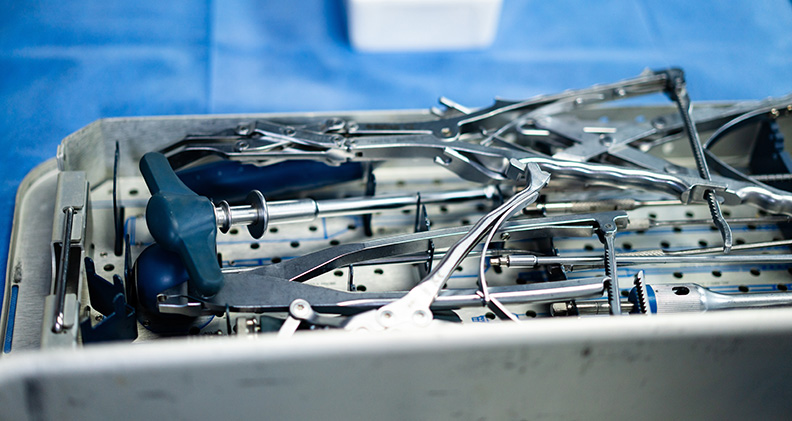
Another important element in the development of precision components is the design and manufacturing of the cases and trays that keep robotic instrumentation properly kitted and protected. They are highly sophisticated and expensive devices that house embedded electronics or critical reference points and can’t be handled like mechanical components.
That extra level of care extends to how they’re stored, sterilized and transported, which makes the design of the case itself a key part of developing robotic parts. It demands working with a contract manufacturer that offers integrated design solutions.
“You need to conduct more upfront development work that incorporates design and manufacturability considerations,” Jablonowski said. “The prototypes we deliver aren’t just concept models. They’re often very close to production-ready parts, built to the same tolerances required for surgical robotic instruments.”
Building for the Future
OEMs and contract manufacturers must also work together to navigate the significant cost of developing robotic components.
“That’s one of the biggest differences compared to traditional instrument development,” Jablonowski said. “When customers develop manual instrument sets, they have room to experiment. They can prototype, weld parts together and test rough concepts that are refined over time. But with robotics, that luxury doesn’t exist.”
Developing a robotic platform demands significant investment, which leaves little room for iteration. The design needs to be dialed in from the start. “By the time it’s in front of surgeons or submitted for review, a tremendous amount of cost is tied up in it,” Jablonowski said. “There’s no flexibility for major changes.”
These heightened expectations require R&D teams to become deeply involved early in the design process. If mechanical parts don’t fit the manufacturing method, there is enough time for recursion. That’s not the case when robotic parts are involved.
“The days of trial and error are essentially gone,” Jablonowski said.
Scalability is the next major hurdle to navigate in the production of robotic components. “It’s one thing to produce ten or even a hundred surgical robotic arms. That’s manageable,” Jablonowski said. “But the real question is, can we scale to thousands?”
As robotic platforms gain traction, large-scale, reliable production is becoming a key consideration. OEM customers demand a sturdy manufacturing network that can withstand today’s international trade challenges.
“It’s important to build in redundancy of manufacturing to scale production levels, which is becoming increasingly important as the demand for robotic parts grows,” Jablonowski said.