

 Copy to clipboard
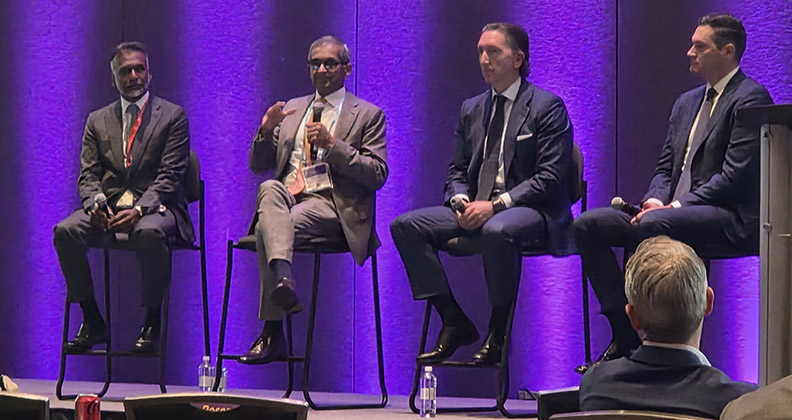
It’s not often that high level executives from the top companies in orthopedics get together to talk about important market trends, so the industry reps and surgeons who attended the AAOS + HealthpointCapital Investment Forum earlier this month at AAOS had a rare opportunity to soak in the insights of Dylan Crotty, Group President, Orthopaedics at Stryker; Deepak Nath, Smith+Nephew, CEO; Namal Nawana, Worldwide President at DePuy Synthes; and Ivan Tornos, CEO and President at Zimmer Biomet.
The executives shared a dais and their thoughts on the market forces that are impacting the industry, and the factors that should guide future advances aimed at improved patient care.
HealthpointCapital Managing Director Mike Mogul moderated the wide-ranging and engaging discussion, which touched on the need to take a broad view of innovation, the importance of value-based solutions as more cases move to ASCs, and the significant economic pressures that impact the decisions orthopedic customers make.
Developing Digital Solutions
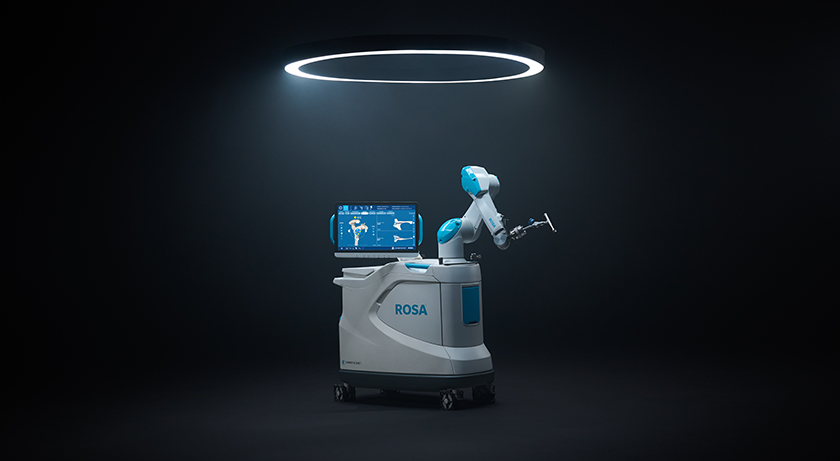
Crotty: When we acquired Mako, many of our own people didn’t necessarily buy into the technology or believe in it. So, the first step was building an internal belief and commitment, which was incredibly important.
I share that because these things take time. We needed to gather clinical evidence to support Mako and develop an entire program around it. That involved creating the installation, service and medical education teams that make adoption seamless. There are so many components across the ecosystem that need to work together for a technology platform to succeed.
When you create new technologies, it’s important to understand where surgical facilities are on their sophistication curve. In some cases, we’ve made solutions too complex to implement at the outset. We’ve learned to introduce them incrementally, starting with something straightforward and then building from there.
That approach has proven to be far more successful. Adoption improves when solutions are implemented in stages and designed to fit more naturally into existing workflows.
Filling Technology Gaps
Tornos: Virtual reality is moving very quickly. AI, in certain applications, is also advancing at a rapid pace.
If you have a technology that is simple to adopt and clearly delivers value, it tends to gain traction much faster. For instance, taking a navigation platform and moving from off-the-grid workflows to a direct computer-based system that dramatically reduces planning time without adding complexity to the procedure can be adopted very quickly. In some cases, we’re seeing faster adoption there than with robotics.
Ultimately, it depends on the problem you’re trying to solve, the data involved and how simple the solution is for surgeons to use.
Nath: It’s important for all of us, large and small companies, to keep in mind what we’re ultimately trying to achieve and what problems we’re solving.
As I’ve come into this field, one issue that stands out is the significant variability in patient care and reducing that variability is important.
A lot of orthopedics has traditionally been about artistry — the look, feel, judgment, and craftsmanship of surgery. Those elements are still important, but from a patient perspective and a healthcare system perspective, reducing variability matters.
Technologies that help standardize aspects of care with improved planning, intraoperative workflows, or diagnostics play an important role in achieving more consistent outcomes.
Controlling the Cost of Care
Nath: The shift of cases toward ASCs, along with the broader economic pressures facing healthcare systems today, are major market forces. There’s enormous pressure to bring costs down and bend the proverbial cost curve. That means making patient care more cost-efficient.
In some ways, that imperative has always existed, but we’re entering an era in which those pressures are only intensifying. Innovation that helps health systems manage costs more effectively will be critical.
Bringing forward innovation, whether through AI or other approaches, that helps simplify logistics and improve efficiency is incredibly important. My advice, both to ourselves internally and to others across the orthopedic ecosystem, is to keep these priorities in mind as we continue to pursue innovation and introduce new technologies.
Tornos: Let’s talk about data as it relates to bundled payments in orthopedics.
When you break down the total cost within the bundle, implants, supplies, and pharmaceuticals account for roughly 15% of the cost of care. The remaining 85% comes from other factors like inefficiencies in the system, surgical time and labor, readmissions and a range of other operational costs.
Yet when we have conversations with customers on the supply side, we tend to focus almost entirely on that 15%. The discussion is usually about lowering implant prices or reducing supply costs. Every year the expectation is that implant costs should come down by 10%. Meanwhile, very little attention is paid to the 85% of costs that exist elsewhere in the system.
That’s where data becomes important. Some of us are beginning to shift the conversation by asking different questions. What if we can reduce surgical time? What if we can introduce technologies that make procedures less dependent on individual variability?
What if we can address elements of that 85% of costs? I believe that’s where the conversations will eventually move.
Ownership and incentives also matter. Many ASCs are owned by private equity groups. The facility operators there tend to understand the financial dynamics much more clearly. But if you go into a large hospital system, you may hear something very different.
A hospital leader might focus only on short-term supply costs and the price of implants over the next quarter. They may not be accountable for labor costs, surgical time or readmission rates — those concerns belong to another department.
If we don’t bring the data to show how we can reduce that 85% of variable costs, and if incentives aren’t aligned so that surgical leaders think more like facility owners, then the conversation won’t change.
But I’m encouraged. For the first time, I’m starting to see pockets in certain regions and organizations where people are willing to have that broader conversation.
Widening Your View
Nath: Innovation usually takes the form of a product that does something better than what came before it. Sometimes those improvements are incremental and sometimes they’re more revolutionary. But our instinct is to focus on solving a specific clinical problem or addressing a particular technical challenge.
What’s becoming increasingly valuable today, though, is something different. More than ever, there’s an imperative to broaden our perspective and open our aperture. That means looking beyond a single product or technology and considering the entire system in which it operates.
For many of us, that type of thinking doesn’t come naturally. And in larger organizations with long institutional histories and deeply ingrained ways of working, shifting that mindset can be difficult.
But the need to adopt a more systems-based approach has never been greater. We need to look at challenges more holistically and take an end-to-end approach if we want to develop broad-based solutions that are truly impactful.
Nawana: In many ways, the industry is maturing and expanding in dimensions that go beyond simply making products. Our customers need us to continue making that progress, and so do our communities.
The quality of clinical outcomes remains the most important measure. If we start looking at all the elements that contribute to quality outcomes, then we can begin to address the broader system of care and not just the device itself.
When you think about the entire patient journey, there are many opportunities before and after a procedure to improve the likelihood of successful outcomes.
That’s why considering the continuum of care is so important. When we think about goals and aspirations as an industry, we should consider the entire pathway. We have made real progress, but it’s not yet consistent across the whole healthcare system.