

 Copy to clipboard
Artificial intelligence (AI) is evolving from an abstract concept into a practical design tool within orthopedic product development circles. Applications initially focused on automating repetitive tasks and early-stage ideation, but today AI is driving much more impactful evolution in device design.
Research and development teams are using machine learning to explore complex design spaces, optimize implant geometries and accelerate simulation-driven testing, compressing iteration cycles from months to days, or even hours. Perhaps most importantly, AI is introducing a new era of personalization, where implants are tailored not only to a patient’s anatomy, but also to internal bone density, lifestyle demands and long-term performance needs.
Navigating Complex Designs
No two bones are exactly alike. In fact, spaces within a single bone in a single person may have varying characteristics. That’s why, when designing an implant for porous bone, in particular, moving implants from design to surgery can be a slog when done manually.
AI, on the other hand, excels in helping engineers tackle design problems involving massive numbers of interdependent variables and spaces too complex for traditional simulation or trial-and-error to solve.
At N.C. State University, Jacob E. Peloquin, Ph.D., Assistant Professor in the Fitts Department of Industrial and Systems Engineering, leads a research team that has used 3D diffusion models to design porous bone implants with varying porosity throughout the structure, matching an implant’s architecture to a patient’s unique bone structure.
AI was used to design lattice patterns that weren’t intuitive to the team as engineers — configurations that simultaneously achieved multiple competing goals: maintaining mechanical strength to support the patient’s weight; reducing the stiffness mismatch between metal and bone, which can cause bone deterioration; and creating the right pore sizes to encourage osseointegration.
“Traditional design optimization methods would require enormous computational resources and integration of simulation software to explore this number of possibilities,” Dr. Peloquin said. “The AI approach revealed solutions we likely wouldn’t have found through conventional geometric design methods alone.”
This multi-scale customization, as Dr. Peloquin described it, allows for implant designs that vary based on patient age, bone density and regional load demands by personalizing not only the overall shape of the implant, but also the internal porous structure. “If we design every implant with the same internal structure, we’re missing opportunities for true personalization that could significantly impact long-term outcomes,” he said.
Implant shape isn’t the only design complexity to overcome, of course. Essentially, implants serve as metal scaffolds that need to serve two competing purposes. They must be strong enough to bear the patient’s weight, but not so stiff compared to the surrounding bone that it weakens the bone over time. At the same time, bone tissue will need to grow into an implant to create strong fixation.
“Using AI-driven diffusion models, we can generate implant designs where the internal architecture is customized to match a patient’s bone density in different regions,” Dr. Peloquin said. “Some areas might be denser for load bearing, while others are more porous to encourage bone tissue integration. This level of optimization is difficult to achieve with traditional design methods because the design space is too complex for manual exploration.”
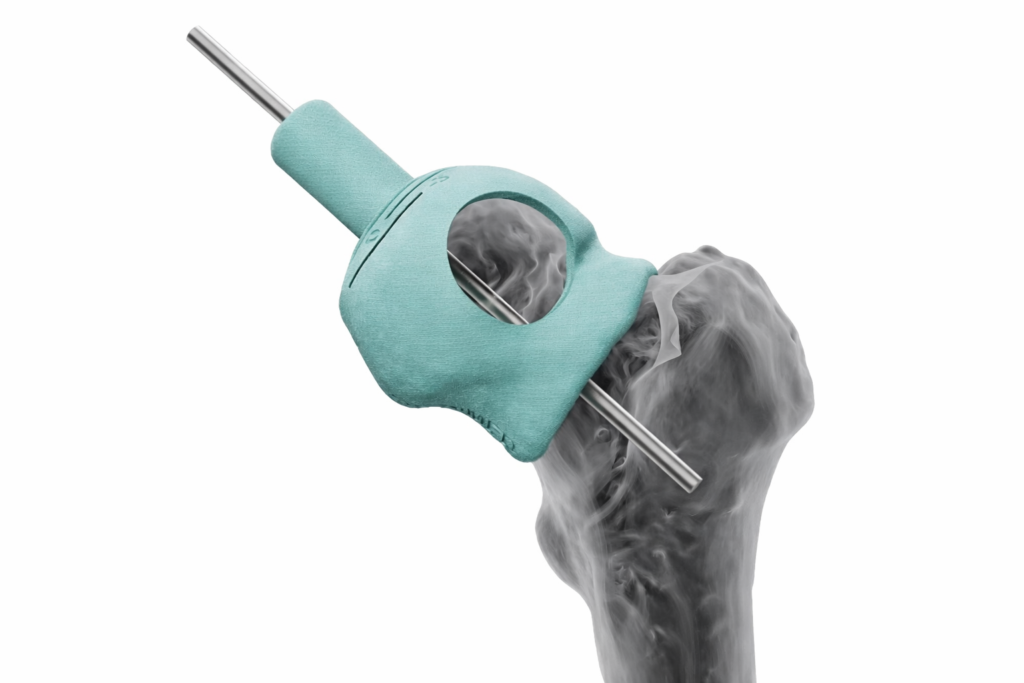
CustoMED’s AI-driven platform turns medical imaging into intelligent, interactive anatomy.
Patient-specific Solutions
In many routine cases, such as hip or knee replacements, most patients’ anatomy falls within a predictable range. With thousands of similar surgeries fed into AI models, personalized implant designs can be generated in hours by learning from a vast library of previous cases, then tailoring the device to fit each patient’s unique bone structure, according to Dr. Peloquin.
“The more challenging cases are the outliers — unusual bone shapes from previous injuries, rare anatomical variations or growing bones in younger patients,” he said. “Here, AI serves as a sophisticated design assistant. It rapidly generates an initial implant concept based on the patient’s scans, giving surgeons and design engineers a strong starting point. They can then apply their clinical experience to refine the design.”
AI’s ability to enable personalized designs on a mass scale moves patient-specific implants from months or weeks of iteration to hours, depending on the case.
CustoMED’s surgical planning platform uses AI and machine learning to help design teams and surgeons dramatically improve workflows by automating labor-intensive steps while preserving and enhancing clinician decision-making through data-driven insights.
The planning platform gives clinicians a starring role in the design process, cutting the back-and-forth between surgeon and designer from weeks to mere minutes, according to Or Benifla, co-founder and CEO of CustoMED.
“We created a tool for the clinicians, having them more involved and giving them the sense of ownership in the design process,” he said. “It’s not like a designer designing something for them based on their instructions. It’s theirs.”
Not only does CustoMED’s process involve the surgeon from a design standpoint, but it also automates a time-consuming, iterative process that could take several weeks. That can happen by inputting data gathered from thousands of designs, previously completed procedures and outcomes. The more the AI platform is used, the more it learns, and the more accurate it becomes.
By having surgeons use the CustoMED platform at the beginning of the design process, their methodology is built into the initial design plan, compressing the time it takes to integrate the design with the clinician’s approach.
“In order for the surgeon to plan that meticulous stage of understanding the angles, the position of the cuts, the position of the implants, the reorienting of the fragments — it’s not accessible with traditional design methods,” Benifla said. “But now, they’re involved. They’re creating the plan.”
Regulation, Validation and Ethical Deployment
As with all advancements in orthopedics, AI faces a slew of regulations that vary by geography and are continuously evolving. Moreover, since AI is still in the sandbox stage in many cases (or very newly out of the sandbox), validation remains a big part of its ramp-up.
The CustoMED team works in baby steps, manually validating every step that they do, and weaving them into their client’s quality management systems or regulatory activities. The client collaborators validate the input and the output to make sure that everything is safe during QA, as well.
The validation is a manual R&D process for a particular device at the onset, prior to automating a workflow. They first design the device manually in the traditional fashion and pilot it with the surgeon to understand every aspect of an implant’s usage. Then they get feedback from the surgeon to understand how to fine-tune the design.
“After finishing several successful surgeries with this specific manual design, we move to parametric design,” Benifla said. “In this step, we create the parameters that create the device, from the engineer’s perspective and from the surgeon interaction perspective.
“We allow the surgeon to work in a semi-automated workflow to capture the clinical decisions and to understand their interaction with the software and what parameters they want to change about an implant’s design.”
After doing batches of these cases, extremely detailed specifications of the devices are fed into CustoMED’s planning software, where AI can utilize that data for future designs.
In addition to validation and regulatory safety, Dr. Peloquin stresses that AI usage bears the responsibility of ethical deployment from a resource standpoint. Advanced generative AI models require significant computational resources.
“Not every implant design problem requires the most sophisticated AI approach,” he said. “For straightforward cases where traditional methods work well, using extensive computational resources for marginal improvements may not be responsible. The key is matching the tool to the clinical need.”

Effective implants incorporate the feedback of surgeons users into how the devices are built and function.
Human Accelerator
While popular narrative (or even an unfortunate reality) in many industries suggests AI as a replacement for the human workforce, that’s certainly not the case when it comes to orthopedic R&D. Instead, AI is seen as a tool, or a force multiplier for orthopedic R&D teams, speeding up analysis and design while preserving clinician decision-making.
“I view AI primarily as a catalyst that accelerates our work and opens new possibilities, rather than replacing human creativity,” Dr. Peloquin said. “AI models are fundamentally trained on existing knowledge. They’re incredibly powerful at recognizing patterns and making connections within that knowledge base, but genuine breakthroughs still require human ingenuity to venture beyond what’s already known or imagined.”
Using AI as a collaborative tool in the design process supports, rather than overrides, human judgment.
“Our role as engineers is to harness AI’s speed and computational power to explore applications that were previously too time-consuming or labor-intensive to pursue,” Dr. Peloquin said. “Ultimately, it’s human ambition that defines the frontier, not the boundaries of what exists in AI’s training data.”
Successful use of AI is a collaborative effort between human and machine, and as AI is finding its footing in orthopedics, each organization is discovering that balance in its own way. “The AI platform amplifies the human, making them more efficient and more productive,” Benifla said. “It’s like always giving you the second opinion that is based on your practice, your colleagues’ practice, tons of research and the science behind it.”
AI is proving to fill some gaps in traditional orthopedic device design, but it can’t solve all problems. Some engineering challenges are still beyond the reach of AI, at least for now. Critical areas, such as material development, for example, still need traditional science, rigorous testing, and human brainpower, Dr. Peloquin said.
“We cannot, and should not, rely on AI to predict new material formulations without conducting comprehensive safety testing, including biocompatibility studies and fatigue analysis to ensure the material won’t fail under repeated loading over years in the human body,” he said. “No amount of computational power should replace the careful empirical validation required for patient safety.”
Other gaps exist in orthopedic device design that may not be best filled with AI solutions, he continued. Material degradation is a frontier where traditional experimental science remains essential.
“Biodegradable metals that gradually dissolve as the bone heals represent an exciting future for orthopedic implants, but we lack the extensive datasets needed for AI to reliably predict how these materials will behave in different patients over time,” Dr. Peloquin said.
As for future breakthroughs, Dr. Peloquin envisions what he calls “4D implant design,” with time being the fourth dimension. Both patient anatomy and implant shape change over time, so the success of the implant a month after surgery may be quite different from the success of the implant a decade after surgery.
Imagine an AI framework that simultaneously addresses multiple factors: The patient’s current bone anatomy and density, how their bone structure might change over the next decade, and, if using biodegradable materials, how the implant’s mechanical properties will evolve as it dissolves.
“Advanced diffusion models and generative AI could design implants with the right shape, the right internal structure and the right degradation characteristics, all calibrated so that years down the road, the patient has the best possible outcome,” Dr. Peloquin said. “This is genuinely difficult to achieve without sophisticated AI — the number of variables creates a design space too complex for traditional methods.”
As AI tools mature, the industry will continue to shift from simple efficiency gains to deeper design intelligence. Engineers and clinicians are already using AI to uncover non-intuitive solutions, predict implant performance with greater confidence and bring patient-specific devices into clinical workflows at unprecedented speed.
“The companies that combine the wisdom of the code with the wisdom of the human are the ones who will make the most of everything,” Benifla said.