

 Copy to clipboard
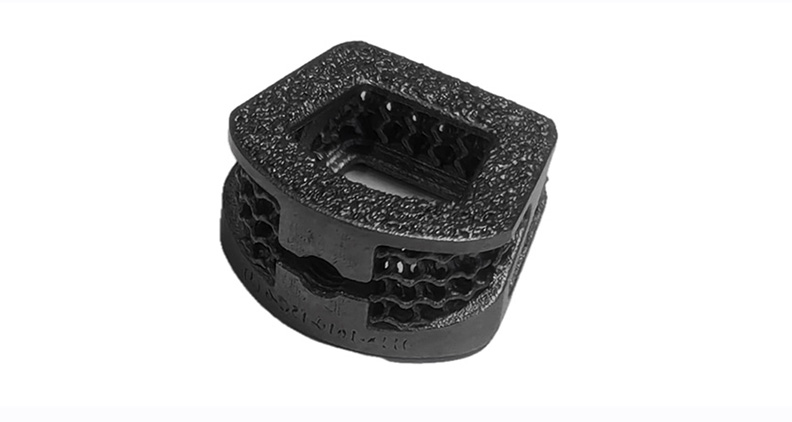
Xenco Medical has 16 different FDA product families in play that include a burgeoning line of biomaterial implants. The company has long been a pure-play spine company, but recently began branching out into orthopedic oncology, foot and ankle and orthopedic traumatology.
Jason Haider, Xenco Medical CEO, wanted the company’s biomaterials platform to spearhead those ventures. To advance the cause, his team developed a simulation platform based on CompuCell3D, an open-source software that allowed the company’s engineers to create in silico models of their previous implant design work.
When the engineers began building the simulation platform, they had access to incredible amounts of clinical scan data but weren’t equipped to identify and quantify where new bone formation occurred versus where residual scaffold or graft material remained.
Enter MONAI, an open-source AI platform that interpreted the imaging data to differentiate regions of bone growth from unincorporated material. The analysis fed directly into the company’s simulation engine, refining the predictive models the team used to drive development of its biomaterial implants.
Xenco Medical has undergone 11 iterations of its biomaterial simulation and plans to conduct several more before bringing the products to market.
“If you think about it, those 11 iterations would have involved 11 preclinical animal studies that each would have taken 12 weeks to complete,” Haider said. “Our use of AI has essentially replaced that entire cycle of animal testing. It powers our simulation platform and accelerates our ability to innovate.”
The Xenco Medical engineers then accessed their library of research data to predict long-term outcomes in device performance. The company’s animal studies typically concluded at 12 weeks, the standard endpoint for assessing bone growth. Haider’s team needed to dive deeper into the data.
“We wanted to show what the six-month time point would theoretically look like,” Haider said. “AI has helped us create those predictions and allowed us to feed them back into our simulation model.”
By combining micro-CT data, histology slides and synthetic data generated by MONAI, Xenco Medical has refined its simulation platform to create a powerful combination of empirical research and predictive modeling that shortens development timelines and reduces the expense of innovation.
Haider pointed out that the cost and time associated with traditional preclinical studies have long been limiting factors for orthopedic companies. “In our space, it costs roughly $150,000 to run a single preclinical animal study,” he said.
“For years, we’ve been tethered to bringing to market a minimally viable product. We simply wanted to meet or slightly exceed the predicate to deliver something surgeons could implant.”
By using AI to analyze and interpret clinical data and pairing it with a simulation platform, Xenco Medical has effectively removed common barriers to advancing device designs.
“We’ve undergone 11 iterations and aim to reach 70 before bringing our biomaterial to market,” Haider said. “Seventy preclinical animal studies would normally cost more than $10.5 million and require approximately 17 years to complete. It’s incredible to think about the impact AI will have on product development in terms of time and money saved.”
Feeding the Feedback Loop
AI has become a powerful tool for exploring architectures that balance strength, biocompatibility and ease of use in surgery.
“We wanted to look at a range of architectures that would be ideal not only for biomaterials and strength, but also for compatibility with various plates,” Haider said. “Ideally, surgeons will use our 3D-printed plates and interbodies, but we also wanted the design to be agnostic. That’s where AI came in. It allowed us to create a wide range of implant configurations that we then shared with our surgeon design teams.”
The creation of 3D-printed implants traditionally requires engineers to design in CAD platforms, share virtual files, print prototypes and iterate over time. AI has added a new dimension to the process.
“We can set the parameters, generate the engineering drawings and let the system create 10 or more variations,” Haider said. “It’s almost like an evolutionary algorithm.”
Xenco Medical’s engineers then run a Finite Element Analysis (FEA) on those models and use the results to explore new configurations and even navigate around intellectual property constraints. That optionality sparks discussion among the design team, allowing them to iterate to improved upon device concepts.
As Xenco Medical continues to refine its AI-driven simulation platform, one of the company’s biggest breakthroughs has come from using MONAI Label, an advanced AI-based learning tool that enhances image interpretation and annotation.
In earlier FDA submissions, Xenco Medical’s team performed these annotations manually. It was a time-consuming and often subjective process. Now, it’s much more efficient.
“We’ve been pleasantly surprised with the effectiveness of MONAI Label,” Haider said. “It’s proven to be a great assistive technology and as we continue to grow, we plan to leverage it even more.”
That next step, he explained, will involve building a collaborative ecosystem in which surgeons can upload preoperative and postoperative CT scans and x-rays from procedures involving Xenco Medical’s biomaterial implants. That will expand the company’s learning model and further refine predictive capabilities with real-world use cases.
“Once our surgeons begin contributing their own imaging data, we’ll have a much richer foundation to work from,” Haider said.
Pairing AI analytics with clinical data submitted by surgeons would create a feedback loop between lab modeling and real-world outcomes.
“Surgeons are already using our biomaterial, and we have all the original data as the manufacturer,” Haider said. “If they share pre- and post-op imaging, we can use MONAI Label and our CompuCell3D simulator to gain insights into how the body’s biology interacts with our material.”
That type of data could reveal patterns in bone regeneration and healing. Surgeons can predict how a mechanical implant will perform, Haider said, but he noted it’s difficult to predict how a biomaterial will behave once it’s inside the body. That’s where AI can play a huge role.
Xenco Medical’s team has also learned how to accelerate the technical side of the process. MONAI Label supports DICOM files, and Haider said that translating imaging data into the NIfTI format has significantly increased processing efficiency.
“That conversion has made a noticeable difference,” he said. “It’s a small technical change, but it’s helped us move even faster as we iterate.”
Haider is particularly excited by the possibility of in silico models being validated and accepted by regulators as a replacement for physical testing.
“You can imagine the impact that’s going to have on R&D,” he said. “Small design teams won’t need huge budgets to run massive trials. They’ll be able to iterate quickly, spin ideas out of their labs, run them through in silico models and get FDA clearance based on those outcomes. It’d be transformative.”
Haider believes such a shift would democratize innovation in medical technology, lowering barriers for startups and research groups while reducing the inertia that slows the introduction of new ideas. “We’ll no longer have the big players dictating what kind of technologies come to market,” he said. “It would open the door for truly novel products.”
restor3d’s iTotal Identity CR 3DP Porous Total Knee Replacement System integrates patient-matched design with advanced 3D-printed porous technology.
Primed for Personalization
restor3d was one of the original adopters of personalized medicine and remains focused on developing patient-specific devices and implants.
“In the early stages, patient-specific implants couldn’t be scaled,” said Brianna Prindle, Director of Regulatory Affairs at restor3d. “Everything, from the segmentation process to device design and manufacturing transfer, was handled on a case-by-case basis. It was effective for individual patients, but not sustainable in large volumes.”
restor3d now uses AI and continuous learning models to change that equation. The company has integrated automation across the entire workflow, beginning with segmentation and extending through design optimization, manufacturing transfer and final production.
“We’ve leveraged AI to bring automation into each of the steps,” Prindle said. “That allows us to make the entire process scalable, repeatable and much more efficient. It helps us achieve better device consistency and higher manufacturing yields. Because we’re using repeatable automated methods to prepare devices for additive manufacturing, we’re seeing better performance and more reliability across the board.”
As AI becomes increasingly embedded in medical device design and manufacturing, Prindle said data ownership and integrity become important issues.
“Data is one of the biggest questions when it comes to AI, particularly when it’s being used to develop personalized implants,” Prindle said. “Who owns that data? How do we protect it, and how do we make sure it’s being used responsibly?”
Prindle said introducing AI automation into the implant design has allowed restor3d to create “first, best-guess” templates, which serve as starting points that engineers and technicians fine-tune for individual patients.
restor3d once relied on engineers to model each implant from start to finish. The AI-assisted process now enables designs guided by standardized, step-by-step digital frameworks. It’s more consistent and reliable.
“We’ve transitioned from engineer-based designs to more technician-based designs,” Prindle said. “AI models provide structured and repeatable workflows that help ensure consistency from one operator to another.”
For restor3d, the combination of time savings, scalability and consistency is paving the way for increased interest in patient-specific implants.
“Ultimately, that’s the goal,” Prindle said. “We want personalized implants to be not only possible, but practical — something that can be adopted broadly across orthopedics.”
Pushing for What’s Possible
One of the most important early lessons learned during restor3D’s implementation of AI was that the technology can only function effectively when built on a well-defined process.
“You can’t create AI pathways out of something that’s not well defined,” Prindle said. “That was a big lesson for us. You need a stable, structured process with strong data behind it. Create clear definitions of what constitutes a good segmentation, a good device design and accurate implant sizing.”
According to Prindle, using AI throughout the device development process helps engineers achieve better design outcomes earlier in the cycle. That means the implants that reach patients are more personalized and perform better.
Prindle acknowledged that AI’s promise won’t be fully realized until regulatory frameworks evolve to meet it. Many companies hesitate to invest in AI-driven processes because of uncertainty around how regulators will evaluate them.
“Right now, a lot of companies look at AI as an option, but then decide it’s too difficult to approach,” Prindle said. “You can run in silico trials and use AI to guide testing, but if those methods aren’t recognized or accepted during device approval, the value is lost.”
She believes the key to regulatory acceptance lies in persistence, transparency and continuing to demonstrate the reliability of AI-assisted methods through consistent application and data-backed validation.
“Getting regulators over the hurdle of engaging with AI is critical,” Prindle said. “The best way to get there is to keep using it, keep learning from it and continue applying what we’ve learned to future projects.”