

 Copy to clipboard
Researchers at Flinders University in Australia have developed a next-generation scaffold that’s designed to prevent infections and repair bone. The hydroxyapatite (HAp) material is embedded with silver–gallium (Ag–Ga) liquid-metal nanoparticles to create durable and potentially long-lasting orthopedic implants with antimicrobial properties.
“Our work aims to develop devices that are not merely inert supports but living, adaptive systems that can sense, respond and heal in synchrony with the human body,” said Vi-Khanh Truong, Ph.D., Associate Professor at Flinders University.
Implant-associated infection remains one of the most costly and devastating complications of hip and knee replacement surgeries. Traditional antibiotic coatings provide only short-term protection, and their “burst” release can lead to drug resistance or damage to surrounding tissue.
Dr. Truong, lead author of a study recently published in Advanced Functional Materials that detailed the new implant material, said his team wanted to move beyond passive coatings.
“The study shows that our scaffolds significantly reduce bacterial colonization at implant sites and promote healthy bone integration, confirming both antibacterial efficacy and regenerative capability in a physiologically relevant setting,” he said.
Dr. Truong’s first breakthrough involved a silver–gallium nanoparticle that killed tough bacteria without damaging human cells. “In the latest study, we translated that chemistry onto HAp, a widely used bone-mimetic ceramic, to create a single-step surface that integrates antimicrobial function with osteogenic support,” he said.
According to Dr. Truong, the resulting HAp–Ag–Ga nanoparticle interface engages multiple antibacterial mechanisms — reactive oxygen species, membrane damage, metabolic (ATP) suppression and broad macromolecular disruption — while lowering in vivo colonization and facilitating tissue integration. He noted that this development represents a substantive progression from passive, protective coatings to an integrated, bioactive interface for infection control where implants meet bone.
“We’re the first to engineer HAp with Ag–Ga nanoparticles as a multifunctional medical surface that pairs broad-spectrum kill, including MRSA and small-colony variants, with bone-healing cues,” Dr. Truong said.
Dynamic Support
HAp is like natural bone both chemically and structurally, making it one of the most clinically established bioceramics in orthopedics. But Dr. Truong’s team sought to make it “biointelligent,” meaning that it’s capable of interacting dynamically with living tissue.
“By functionalizing HAp with our Ag–Ga liquid-metal nanoparticle coating, we transformed a passive scaffold into an active interface that supports cell adhesion and bone mineralization while continuously killing bacteria on contact,” he said.
Dr. Truong is excited that the approach creates a precision-engineered surface, not just a coating layer. “The liquid-metal chemistry allows nanoscale uniformity and self-regulated ion release, giving the scaffold both long-term safety and performance stability,” he said. “These elements make the interface more predictable and reproducible.”
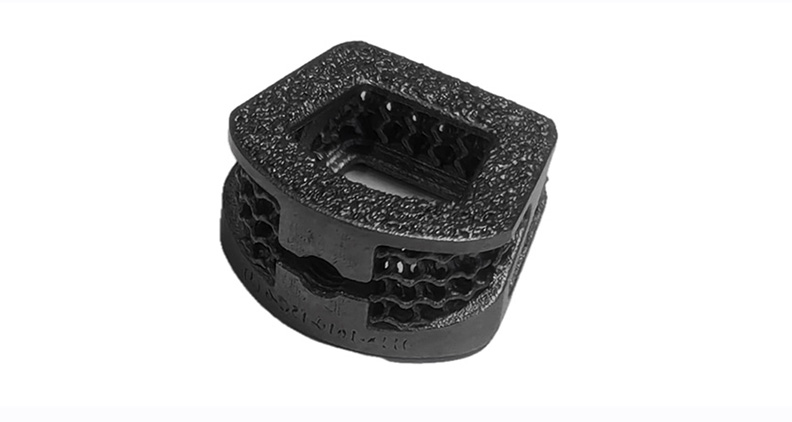
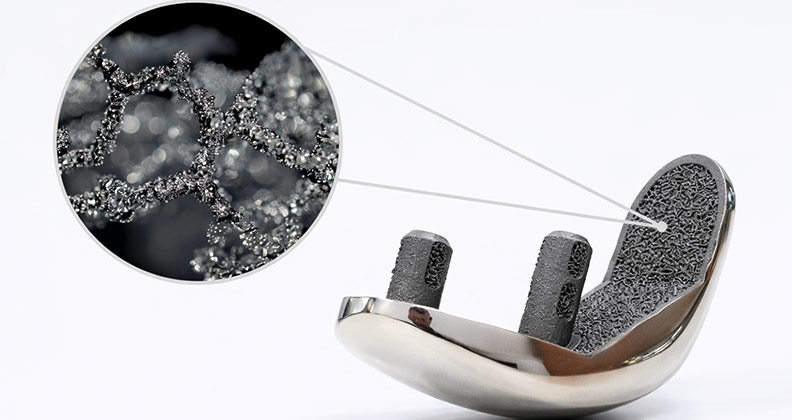
The same principle could extend to personalized 3D-printed implants, for which the geometry is tailored to a patient’s anatomy and the surface chemistry is tuned to their biological response.
“We envision the ability to create orthopedic scaffolds made of personalized, infection-resistant and pro-regenerative materials that not only fit the patient perfectly but also actively participate in healing,” Dr. Truong said.
Designing a biomaterial that’s capable of inhibiting bacterial colonization and supporting tissue regeneration presented Dr. Truong’s team with a fundamental challenge. Upon implantation, the material encounters complex and often competing biological pressures.
The host immune system must respond to potential pathogens, but an overly aggressive antibacterial response can damage cells and provoke inflammation or immune rejection. Achieving an optimal equilibrium between antibacterial efficacy and immunological compatibility was therefore central to the design strategy.
Integrating a Ga liquid-metal with a HAp ceramic also added complexity to the project because of their contrasting surface energies. Ga is metallic and fluidic, while HAp is rigid and crystalline. To address this issue, Dr. Truong employed a controlled wetting and galvanic reaction approach, enabling Ga droplets to self-anchor and uniformly distribute nanoparticles across the HAp surface.
The process generated a stable, nanoscale antibacterial interface without compromising the intrinsic bioactive sites that are essential for osteogenic cell attachment and mineralization, Dr. Truong said.
Another critical aspect of the scaffold’s design involved maintaining immune equilibrium and cytocompatibility.
“Although silver ions exhibit potent antimicrobial activity, uncontrolled release can induce cytotoxicity and inflammatory responses,” Dr. Truong said. “Ga mitigated this issue by forming a self-regulating, nano-amalgam that moderated ion release kinetics to provide continuous antibacterial protection while preserving the viability and function of osteoblasts and immune cells.”
Slow and Steady
Conventional antibacterial coatings often rely on a rapid “burst” release of antimicrobial agents or ions. Although this rapid release is effective in the short term, Dr. Truong said the effect diminishes quickly and can induce bacterial stress responses that promote antibiotic resistance.
He added that the transient exposure frequently fails to prevent late-stage infections by leaving implants vulnerable once the initial drug reservoir is exhausted.
In contrast, the liquid-metal Ag-Ga nanoparticle matrix exhibits a self-regulating and sustained ion-release profile.
“It serves as a dynamic reservoir that gradually liberates Ag and Ga ions in a controlled manner, maintaining antimicrobial activity throughout the critical post-implantation period,” Dr. Truong said. “The gradual release ensures long-term antibacterial function while avoiding cytotoxic peaks that could damage surrounding tissues or disrupt osteogenesis.”
Dr. Truong noted that the scaffold’s multitarget antibacterial mechanism minimizes the likelihood of antibiotic resistance and effectively targets persistent bacterial phenotypes, including small-colony variants that typically survive conventional therapies.
According to Dr. Truong, sustained and controlled antibacterial action is essential for continuous protection during bone healing and for overcoming one of the most pressing challenges in orthopedics: preventing infection recurrence driven by antimicrobial resistance and bacterial persistence.
“Our material transcends conventional sterilization by establishing a biointelligent interface capable of coexisting harmoniously with host tissues,” Dr. Truong said. “Rather than merely resisting infection, the scaffold functions as a precision biointerface that modulates biological interactions, selectively eliminating pathogens while fostering tissue repair. This paradigm represents the next generation of implant materials that are designed to work synergistically with, rather than against, the immune system.”
Personalized Protection
Dr. Truong’s team ultimately wants to print bone, not just replace it. “Our vision is to engineer functional, infection-resistant constructs that can precisely restore large bone defects where traditional grafts or implants often fail due to infection, immune rejection or poor integration,” he said.
By combining additive manufacturing with nanoscale surface engineering, the researchers can control the architecture and bioactivity of the implant.
The next phase of their work will focus on precision 3D printing, AI-guided surface optimization and scalable fabrication to produce patient-specific scaffolds, which will be designed to modulate the immune response, support vascularized tissue growth and maintain long-term antibacterial protection that’s critical for healing large, load-bearing bone defects.
“Our preclinical roadmap includes large-animal models to evaluate osseointegration, immune tolerance and antibacterial durability under physiological conditions,” Dr. Truong said. “The studies will lay the foundation for first-in-human clinical trials with the goal of establishing a new clinical standard for infection-proof bone repair within the next three to five years.”