

 Copy to clipboard
How hot is the ASC market?
“Molten hot,” said Charlie Young, Vice President of ASC Solutions at Enovis. “There are two mega-trends at play, and they’re both worth double-clicking on.”
According to Young, the convergence of advanced technologies and clinical expertise are contributing to the increasing numbers of cases that are shifting to ASCs. He referenced a Trilliant Health report that projected a 50% year-over-year increase in outpatient procedures between 2025 and 2026.
“Everything that’s been building over the past 15 years now seems poised for a sharp inflection point,” Young said. “The outpatient shift could accelerate faster than anyone had anticipated.”
Value-added Solutions
The biggest constraints to same-day surgery growth might not be clinical. “The two factors that will likely gate ASC volumes are whether facilities have enough capacity to handle a significant influx of cases and whether surgeons feel confident they can perform procedures safely and efficiently,” Young said.
Over the past decade, Enovis has focused its resources and R&D efforts on supporting the entire continuum of patient care. The company can offer ASCs a comprehensive portfolio that spans preoperative prep, early osteoarthritis management, surgical technologies, post-op rehabilitation and PT solutions.
That comprehensive approach is particularly valuable for ASCs, which increasingly need to consolidate vendors and streamline operations.
“ASC operators want to limit the number of supplier relationships and save valuable storage and floor space,” Young said. “They also want to align technologies that optimize patient satisfaction and clinical outcomes while driving revenue growth and reducing costs. That’s what drives real value for ASCs.”
In 2018, Enovis invested in OaraScore, a proprietary algorithm that helps identify which patients are the best candidates for outpatient procedures. Young believes tools like that will become more relevant as surgeons and ASCs navigate how to safely scale case volume.
He has spoken with many ASC operators and constantly hears that the metrics they care about most are overhead costs per surgeon and revenue per surgeon from all sources, including the ancillary services that can add significant value.
“Experienced ASC leaders who are focused on long-term economic viability want to know how their facilities can be vertically integrated and capture revenue from the full patient journey,” Young said.
Hospital purchasing decisions often happen several layers down in the organization. ASCs are smaller and leaner organizations, allowing them to be much more efficient in their decision-making. Many purchases are made by surgeon owners who will benefit directly from using the devices they’re buying.
“When we go into an ASC and present the value proposition of working with us as a sole-source partner, we’re not talking to a category manager. We’re talking directly to the owners,” Young said. “That allows us to clearly communicate the economic benefits in a way that resonates with them.”
For example, Enovis’ Adaptable, a mechanical limb positioner and retractor holder, is ideal for the ASC environment.
Unlike specialty tables used for procedures like direct anterior hips that can run $60,000 to $75,000, this lightweight solution attaches to a standard operating table for a fraction of the cost.
“More importantly, the holder eliminates the need for an extra surgical team member at the bedside, a major advantage amid ongoing staffing shortages,” Young said. “It’s a fixed asset that improves efficiency, especially in smaller operating rooms, where freeing up a staff member and physical space around the surgical table makes a significant difference.”
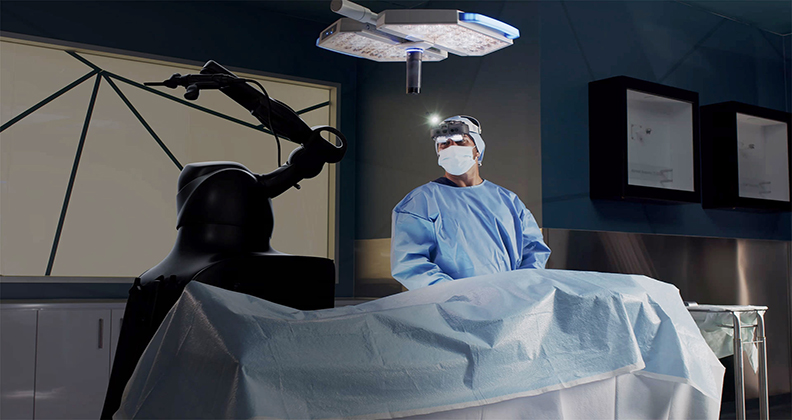
Enovis’s augmented reality (AR) platform — formally ARVIS and rebranded as Astra AR — continues to generate momentum, particularly in the ASC market. “AR technology is inherently ASC-friendly,” Young said. “It’s compact, cost-effective and easy to integrate from a spatial and economic standpoint.”
Several orthopedic companies have made tremendous strides in advancing surgical robot technology, but most ASCs lack the budget or floor space to add a unit. Enovis hopes that Astra AR addresses those concerns. The system’s headset has a “zero O.R. footprint” because it does not require a bulky base unit or external equipment. It’s also a cost-effective navigation option.
“There’s a lot of noise around whether a robot is sold as a capital purchase or through pull-through implant placements, which makes normalization tricky,” Young said. “But when you strip away that element, Arvis is about $1,000 cheaper per case than a traditional robot. In today’s ASC economic environment, where every $100 or $200 counts, those savings are compelling and difficult for ASCs to ignore.”
Special Delivery
Cory Layman, Business Development Engineer at Guardian Medical, has noticed that many OEMs are maintaining a presence in traditional hospital settings while shifting their attention toward the growing ASC market. He believes some OEMs might not yet fully recognize the opportunity of adopting sterile, ready-to-use instrumentation that’s specifically designed to serve the needs of ASCs. However, that’s slowly changing.
Hospital systems often absorb the cost and logistical burden of reprocessing surgical instruments. That dynamic doesn’t exist in ASCs, which typically don’t have the reprocessing infrastructure to handle large instrument sets, leading OEMs to supply sterile-packaged instruments and implants.
That financial and operational shift is a significant change for many device manufacturers.
“It’s definitely becoming a bigger topic of conversation,” Layman said. “Even companies that aren’t ready to switch to sterile packaging today are starting to have those early discussions. They’re dipping their toes in the water so that when the time comes, they already understand what’s involved and how to get started.”
According to Guardian, roughly 15% of its initial discovery calls now come from companies that are exploring the shift to sterile packaged instrumentation. They’re not yet ready to commit resources or funding, but recognize that the ASC trend is reshaping expectations for how products must be delivered.
The movement of cases to ASCs is not only changing where procedures are performed but also how OEMs think about their product strategies. Unlike hospitals, which handle a broad mix of procedures and instrument sets, ASCs typically focus on highly specialized cases.
That narrower procedural focus impacts the entire supply chain. It means less product mix and an emphasis placed on higher-value instrumentation and, in turn, a greater willingness from OEMs to invest in sterile packaging.
“It’s a cost burden, of course,” Layman said. “But when you’re dealing with highly specialized products, that investment makes sense.”
When it comes to sterile packaging for ASCs, space efficiency is one of the most immediate advantages. Pedicle screws that are packaged in a standard pouch come in an overpack carton. Layman noted that Guardian’s packaging tubes eliminate the carton, reducing the storage footprint by about 75%.
That smaller footprint can make a big difference in an ASC environment. “The facilities often have less storage and O.R. space than a hospital,” Layman said. “So being able to fit a full screw set in half the space is a major benefit. It saves room on the shelves, but also on the staging tables in the O.R. You can fit all your implants and instrumentation on a single table instead of two.”
The second major advantage is visibility and traceability. “With a lot of traditional packaging, you can’t easily see the implant,” Layman said. “Our tubes are designed so the implant is always visible. Surgical team members can quickly confirm the part and check labels.”
Each tube can also be clearly marked with identifying information. “Customers can add text to the cap — screw diameter, length, whatever’s relevant,” Layman said. “It’s a simple but effective way to support identification and traceability, which are cornerstones of quality management.”
Surgical teams are also interested in aseptic transfer and intuitive use at the sterile field, which minimizes contamination risk and streamlines workflows.
“Surgeons and staff at ASCs want a sterile, easy-to-handle product that keeps the implant protected and the handling process simple,” Layman said. “Those factors make packaging systems a strong fit for the ASC environment.”
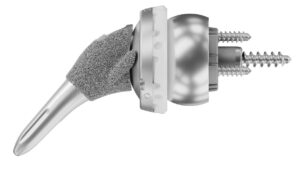
Shoulder Innovations’ product design philosophy includes helping surgeons improve outcomes and reducing costs tied to O.R. time and surgical readiness.
Shouldering the Load
Streamlined instrumentation is one of the competitive advantages Shoulder Innovations holds in the ASC market. CEO Rob Ball said his company’s goal was to provide surgeons with everything they need to replace shoulders with just two trays of instrumentation.
An ASC faced with the burden of reprocessing multiple instrument trays might only be able to perform one shoulder replacement per day.
“With our streamlined sets, the same center could perform multiple procedures,” Ball said. “As we’ve transitioned our products to the ASC market, we find ourselves in an advanced position because of that strategy. Being able to deploy our entire product line within a two-tray set of instrumentation provides a major economic advantage relative to the rest of the market.”
According to Ball, shoulder arthroplasty still lags behind other total joint replacement procedures in terms of implant survivorship. For knees or hips, he said, survivorship rates are typically 85% to 90%. Shoulders, by contrast, are usually in the mid- to high-80% range.
“The gap highlights significant opportunities to address clinical problems for which surgeons are actively seeking solutions,” Ball said.
Ball believes his company’s implant designs offer a differentiating advantage and explained that articulation in shoulder arthroplasty involves translation and rotation forces. Managing them could improve implant durability.
“As the humeral head translates across the glenoid surface, it can reach one extreme position, creating a lifting action at the opposite side,” Ball said. “Then, as it translates back across the joint, the opposite occurs to create a rocking horse motion.”
To address this issue, Shoulder Innovations replaced an ovular humeral head shape with a round one. Because the glenoid is round, the design change allows surgeons to use a round reamer that stays completely within the glenoid margins, making surgical positioning much easier.
It also creates a pocket within the glenoid that provides a surrounding subchondral bone surface, effectively positioning the implant within a natural bony buttress.
“This design helps minimize the rocking horse motion, which can approach a full millimeter of displacement that results in a visible, macro-level lift of the glenoid off the bone,” Ball said. “Reducing that magnitude of motion has translated directly into improved clinical outcomes.”
In September, Shoulder Innovations commenced full commercial launch of the InSet 70 Humeral Stem, an expansion of the company’s I-Series humeral stem product line. InSet 70 is indicated for use in anatomic and reverse shoulder arthroplasty.
Reverse shoulder replacements are gaining momentum. Ball said Shoulder Innovations has seen the rate of reverse shoulder replacements increase from roughly 30% to nearly 70% over the past 10 to 12 years.
“That growth has accelerated our understanding of reverse biomechanics, and the field is now transitioning from onlay arthroplasty toward inlay implant designs,” he added.
The overall outpatient shoulder replacement market represents a significant growth opportunity for companies that are positioned to take advantage of the trend. In December 2023, 10% of surgeries involving Shoulder Innovation’s implants were performed in ASCs. After CMS approved reimbursement of shoulder replacements performed in ASCs at the start of 2024, that number jumped to 30% by December.
Ball noted that Stryker, Zimmer Biomet, Arthrex and Enovis account for roughly 75% of the shoulder arthroplasty market and he’s often asked how his company can compete among the biggest players. “Most of the companies still require eight to ten trays of instrumentation for cases performed in ASCs, making the market ripe for opportunity,” he said.
InSet 70’s stem is intentionally shorter than a traditional stem to help with bone preservation and make procedures more efficient to perform. It also simplifies future revisions while lowering the risk of intraoperative complications.
“What sets it apart, though, is the unique inset or midlay design,” said Jeff Martin, Vice President of Product at Shoulder Innovations. “It’s essentially a hybrid between inlay and onlay concepts, combining the strengths of both while minimizing their drawbacks.”
Martin highlighted three pillars to Shoulder Innovations’ product design philosophy: implant survivorship; helping surgeons improve outcomes; and reducing costs, especially those tied to O.R. time, sterilization and surgical readiness.
InSet 70 hits on all three.
Martin said the device’s stem is designed to achieve strong metaphyseal fixation without the excessive bone removal often seen with traditional inlay designs.
“That’s accomplished through a combination of thoughtful stem geometry, a titanium plasma-spray coating and a streamlined surgical technique,” he added. “Because it’s a short stem, it requires very little humeral canal preparation, which helps preserve bone and make future revisions more straightforward to perform.”
InSet 70’s stem also features a lateralized humeral design with an anatomic neck-shaft angle.
“When that’s combined with a lateralized glenosphere, like the one in our system, studies have shown the configuration provides greater stability, restores the tuberosities to a more natural position, improves range of motion and helps reduce complications,” Martin said. “On top of that, surgeons have said that the unique inset or midlay design makes it easier to consistently position the implant well and, when needed, convert from an anatomic to a reverse configuration in a biomechanically sound way.”
According to Martin, InSet 70’s design could result in meaningful bone conservation, excellent postoperative joint range of motion and fewer adverse outcomes.
As part of Shoulder Innovations’ two-tray system, Martin said, InSet 70 helps surgical teams work faster and smarter. The streamlined instrumentation reduces case setup time, lowers sterilization and processing costs and speeds room turnovers.
According to Martin, sterilization costs can drop by as much as 50% compared to traditional four, five or six tray shoulder replacement systems.
InSet 70 also meshes with the clinical requirements of outpatient surgery, which involves sending patients home soon after surgery ends.
“From a design standpoint, it fits well with same-day surgery discharge protocols because it requires less bone removal, supports faster surgical times and reduces surgical invasiveness, which leads to quicker recoveries and a lower risk of complications like intraoperative humeral fractures,” he said.
Shoulder Innovations has seen a significant shift in its ASC mix and tabs the InSet 70 launch as a key and intentional part of the company’s strategy to connect with customers in the outpatient setting. Combining InSet 70 with the company’s InSet Stemless, Inset Short and I95 intermediate-length stems provides surgeons with a flexible, two-tray solution for primary anatomic or reverse shoulder replacement, regardless of patient size, bone quality, age or activity level.
“We’re committed to delivering devices that help ASC teams set new benchmarks for efficiency, cost-effectiveness and procedural performance while driving measurable value,” Martin said. “We’re entirely focused on developing innovations in the upper extremity space and plan to continue that trajectory.”
It’s another example of solutions that are designed for the same-day surgery setting, a market that continues to grow in importance and influence. Orthopedic companies with an eye on future market success are paying close attention.