

 Copy to clipboard
With decades of success behind them, total joint replacements are already some of the most successful surgeries in orthopedics. But there’s always room for improvement.
VISIE, a 3D computer vision and spatial computing company, introduced Continuous Anatomic Auto Tracking (CAAT) technology to address the worst-kept secret in orthopedics: Nearly a quarter of patients who undergo knee replacement surgery are less than satisfied with the results. “The industry has become more honest that knees don’t perform as well as hips,” said VISIE CEO Doug Fairbanks. “We asked ourselves what we could do about that.”
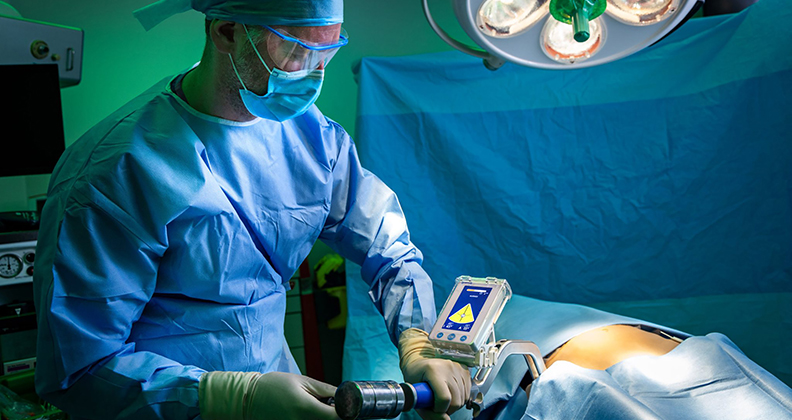
VISIE, a 3D spatial computing platform that combines custom hardware with a proprietary algorithm, employs digital scanners that capture hundreds of thousands of data points within a fraction of a second. These data points are quickly registered to a CT scan, allowing VISIE’s 3D scanners to track the femur or tibia as they move during surgery.
Integrated robotic arms then move in sync with the knee; seamless tracking of the joint’s motion occurs without the use of traditional fixation pins, allowing surgeons to see the precise cut plane throughout surgery.
In July 2025, the company announced the first pin-free knee bone cuts using its CAAT technology when surgeons successfully performed total knee bone resections on cadaver tissue, without the use of pins, clamps, arrays or manual registration.
Fairbanks points out that current tracking methods require surgeons to drill holes in a joint’s bones to place registration pins. “This area is ripe for innovation because of complications like pin site fractures and challenges associated with the movements of those pins and arrays during surgery,” he said. “Plus, those extra holes in the patient may get infected.”
VISIE’s CAAT technology is classified as a subcomponent, meaning the company needs to meet FDA’s imaging standards. “The challenge with the device is that a camera on its own does not treat the patient,” Fairbanks said. “Ours gets built into a company’s robotic platform to solve the physical technology and digital connection issues, and then the company files a letter with FDA to get clearance for the entire platform.”
Fairbanks said that VISIE has fielded many requests from the makers of orthopedic robots for exclusive use of the CAAT technology, but he wants to keep it in an open format to reach more surgeons.
He believes the ability to track anatomy in real time without pin fixation represents a significant step forward in robotic-assisted knee replacement surgery by offering more precise joint alignment and reducing the need for time-consuming manual adjustments of navigation tools during surgery.
“When we talk about the surgeon experience, we don’t talk about the technology as just being nice to have, but instead that it has tangible effects on patient care,” Fairbanks said. “Less anesthesia used on patients, less time in the O.R., less exposure to infection risks — these are all really positive things.”
Hip to What Surgeons Need
With so many companies competing in the joint replacement space, what will likely set solutions apart? Sujit Dike, CEO of Gyder Surgical, believes products that support the movement of cases to outpatient settings represent significant growth opportunities.
In February 2025, Gyder Surgical received FDA 510(k) clearance for the GYDER Hip System, the first commercially available pin-less and image-less navigation tool for positioning the acetabular cup during anterior hip arthroplasty. The company previously received Australia’s TGA regulatory approval. Surgical cases have already been successfully performed with the system in Australia and India.
In developing the system, Gyder’s team considered surgeons’ pain points, which boil down to a need for greater efficiency, portability and cost-effectiveness. To meet those concerns, GYDER Hip’s computer-assisted navigation tool provides surgeons with precise spatial positioning feedback to align the acetabular cup, eliminating the need for invasive pinning fixtures and lengthy robotic setups.
Dike believes the platform can contribute to improved patient outcomes. “Unfortunately, surgeons sometimes end up operating outside of their target zone, which can lead to complications such as dislocations, liner implant wear and tear osteolysis, as well as other issues related to misaligned implant positioning,” he said.
Placing pins in the joint to register robotic systems can also be problematic, potentially leading to complications like infection and lingering postoperative pain. Dike reports that GYDER Hip’s registration process can be completed in about two minutes, which he calls “one of the fastest” registration technologies on the market.
“When you compare that with existing robotic or pin-based technologies, two minutes is a major advantage for high-volume surgeons,” he says. “Many of them perform cases in 30 to 40 minutes, so any technology that adds significant amounts of time to their workflows is not going to be appealing.”
GYDER Hip has also eliminated the use of intraoperative imaging, reducing radiation exposure for surgeons and staff. “Many recent publications suggest that female orthopedic surgeons have a higher risk of developing breast cancer because of that occupational exposure,” Dike said. “Image-less navigation is a way to make surgery safer for surgeons and patients.”
The system’s small footprint is also an important feature.
“With the trend toward performing hip procedures in an outpatient setting, one of the important things to recognize is that many ASCs work on lean staffing models and don’t have large physical infrastructures,” Dike said. “Portable systems that can be easily moved from room to room and require minimal setup time are crucial in this setting.”
Importantly, GYDER Hip is implant-agnostic. “Surgeons all have their favorite implants,” Dike said, “and we don’t want to interfere with those preferences.”
Gyder Surgical is working toward earning FDA clearance for a posterior approach for total hip arthroplasty. “We have learned a lot from developing our system for the anterior approach and are bringing that learning into the posterior technique,” Dike said. “But our philosophy is still the same: we want to maintain pin-less and image-less surgery.”
The company is planning a limited, controlled launch of GYDER Hip targeting early adopter surgeons. “Following that, we’re looking to expand and go into full nationwide launch,” Dike said, adding that the company is also looking to expand their distributor partnerships.
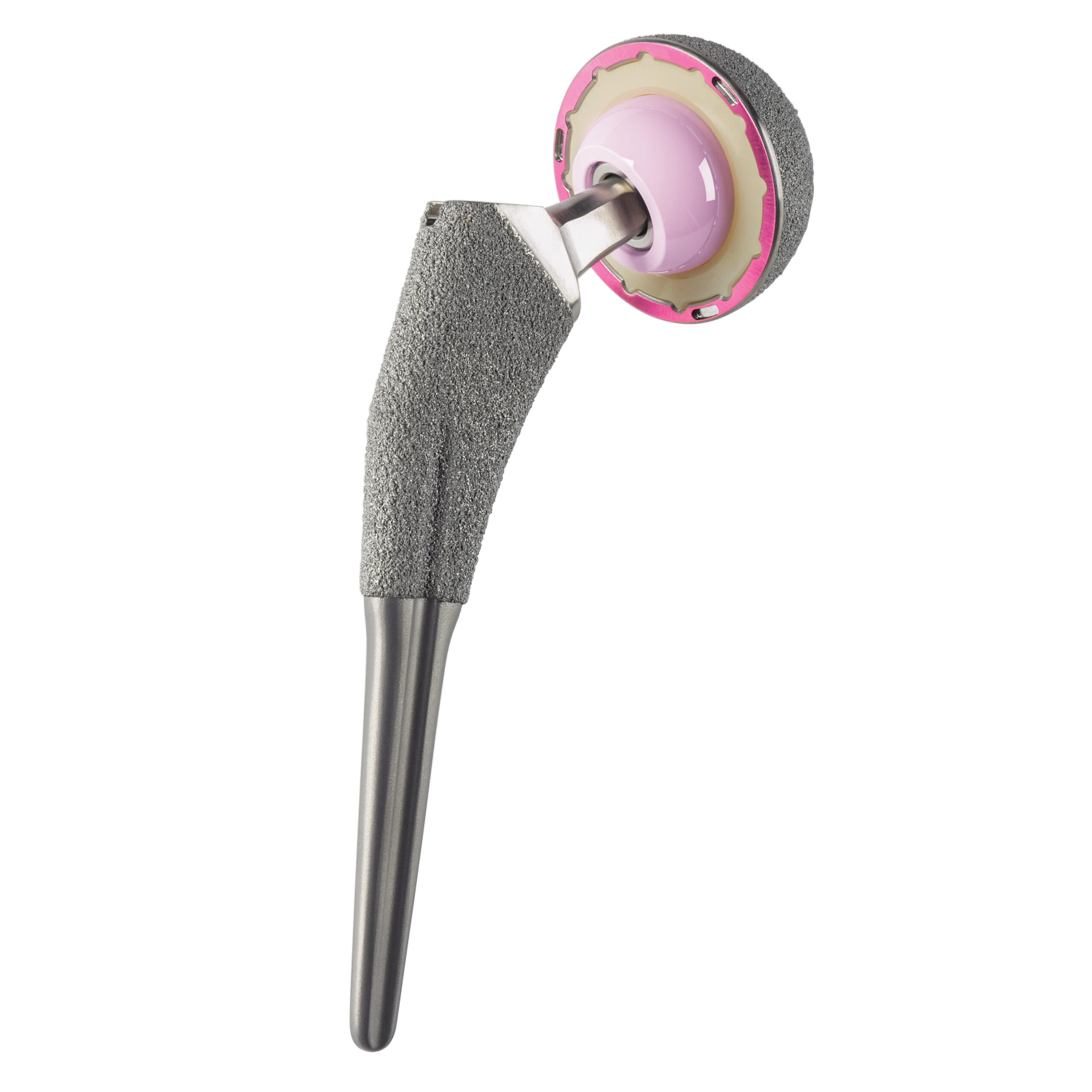
The iTaperloc Complete and iG7 Hip System integrate a controlled-release iodine layer through advanced anodization and electrophoresis to inhibit bacterial adhesion and biofilm formation.
Preventing Infections at the Source
Periprosthetic joint infection (PJI) is one of the most common causes of joint replacement revisions and a challenging complication to solve. PJI is estimated to occur in 1% to 2% of primary knee replacements and can have serious health consequences. Zimmer Biomet reports that the associated mortality rate approaches the five-year mortality observed in breast cancer (11%) patients and far exceeds that of prostate cancer (1%).
Current aseptic practices include proper patient preparation (skin prep, hair removal, prophylactic antibiotics), adequate air filtration in the O.R. and managing risks from the surgical team, including the wearing of personal protective equipment and the meticulous care of surgical instruments.
There’s no silver bullet that prevents PJI, however.
“Treating the surface of the implant is the next logical step,” said Louis Galrao, Global President of Hips at Zimmer Biomet. “Iodine-treated implants are the next level of protection from bacterial adhesion in the event that bacteria are able to evade the existing aseptic surgical techniques and penetrate the sterile surgical field.”
To take that step, Zimmer Biomet developed the iTaperloc Complete and iG7 Hip System, which contains Iodine Technology that inhibits bacterial adhesion on the implant surface.
Iodine is a biocompatible, essential nutrient that does not cause antibiotic resistance and is commonly used in antiseptic medications. Zimmer Biomet’s Iodine Technology integrates a controlled-release iodine surface treatment into iTaperloc and iG7 system to help to limit PJI risk.
In September 2025, Zimmer Biomet received approval for iTaperloc and iG7 from the Pharmaceutical and Medical Devices Agency in Japan. A month later, the systems were granted FDA Breakthrough Device Designation, a first for the company.
Galrao reports that the industry has been working on this type of technology for a decade. “The approval in Japan is a proof point that iodine surface treatment technology for joint replacement is achievable and a step forward in the potential for all joint implants to have similar surface treatments,” he said.
Zimmer Biomet will perform clinical studies on iTaperloc and iG7 in Japan.
“We want to assess the correlation between the iodine treatment and infection and revision rates,” Galrao said. “By creating implants that inhibit bacteria and biofilm adhesion, it stands to reason there would be fewer complications from those causes, which could lead to fewer revision surgeries.”