

 Copy to clipboard
Additive manufacturing is no longer a neat way for imaginative engineers to cook up cool implants. At least not totally. Orthopedic companies throughout the industry, from the largest players to the smallest startups, are applying advanced printing technologies to the pursuit of the next big thing in implant design. Here are a few companies that are pushing the envelope of what’s possible in patient-specific devices, biological fixation and preservation of natural anatomy during increasingly complex cases.
restor3D
The company continues to leverage its proprietary TIDAL Technology, a porous architecture designed to improve fixation and implant stability, and AI-driven digital designs to commercialize personalized implants at an impressive pace.
The iTotal Identity CR 3DP Porous Fully Personalized Total Knee Replacement earned FDA clearance early in 2025 and was used in its first clinical case in December. The system features 3D-printed porous surfaces on the femoral, tibial and patellar components to optimize the fit and fixation for individual patients. Its patient-specific tibial baseplate is designed to maximize bone coverage while maintaining proper rotational alignment, a critical factor in successful cementless fixation.
In February, restor3D launched the Ossera AFX Ankle Fusion Cage, which features 3D-printed titanium alloy implants with porous structures based on the TIDAL technology for use during complex joint fusions. Design engineers tapped into the company’s comprehensive case data to create sizes for a wide range of patient anatomies.
Then in April, restor3D launched the Aeros Modular Stem System, the latest addition to its Kinos Total Ankle portfolio. Aeros features 3D-printed tibial and talar implants with TIDAL technology-based porous architectures that are engineered to promote biological fixation and long-term osseointegration. It’s the first modular stem tibial implant that can be implanted through a standard anterior approach without bulky external hardware, improving surgical efficiency and implant performance.
restor3D’s patient-specific designs and porous 3D-printed implants streamline surgical workflows and hold the promise of improved patient outcomes. They’re also setting the pace for advancements in personalized surgery.
4WEB Medical
Design engineers often use additive manufacturing to create porous surfaces that mimic cancellous bone and promote bone ingrowth, but 4WEB Medical—the first company to receive 510(k) clearance for a 3D-printed orthopedic implant—has used its TRUSS Implant Technology to engineer 3D-printed titanium architectures that alter biology after implantation to help the healing process.
The technology converts physiological loading into therapeutic mechanical strain at the surgical site to regulate cell behavior, tissue regulation and bone healing and, in turn, improve fusion and long-term implant fixation. The open truss architecture also creates space for bone graft material and allows for bone growth throughout the implant.
Researchers at the University of Pennsylvania’s McKay Orthopaedic Research Laboratory published findings in the journal Advanced Healthcare Materials that backed the biological advantages of 4WEB’s TRUSS architecture. The study showed that the combination of hierarchical surface roughness and the TRUSS structure produced significantly greater osteogenic activity than surface roughness alone, with the engineered architecture generating up to a 30% increase in bone-forming cellular activity by delivering therapeutic strain directly to attached cells.
According to 4WEB, the study’s findings showed that its technology could provide a cost-effective way to generate fusion while reducing dependence on supplemental biologics.
4WEB received FDA 510(k) clearance for its SI Joint Truss System in February. The system features a 3D-printed shell with a titanium core that withstands lateral and axial forces while fusion takes place. The clearance allows the company to enter a fast-growing segment of the spine fusion market and continue to advance its TRUSS technology.
SpinePoint
Traditional titanium interbody cages possess high strength capabilities but are much stiffer than cancellous bone, a difference that creates stress on the implant/bone interface to potentially cause implant breakdown and alter the spine’s natural biomechanics, which could advance degenerative disc disease at vertebrae levels adjacent to the implant. PEEK implants exhibit less stiffness than titanium but can result in poorer bone integration and long-term fixation.
SpinePoint is betting that the next evolution of spine implants will focus less on improving surface architecture and more on reducing the stiffness of devices to replicate the mechanical behavior of native bone.
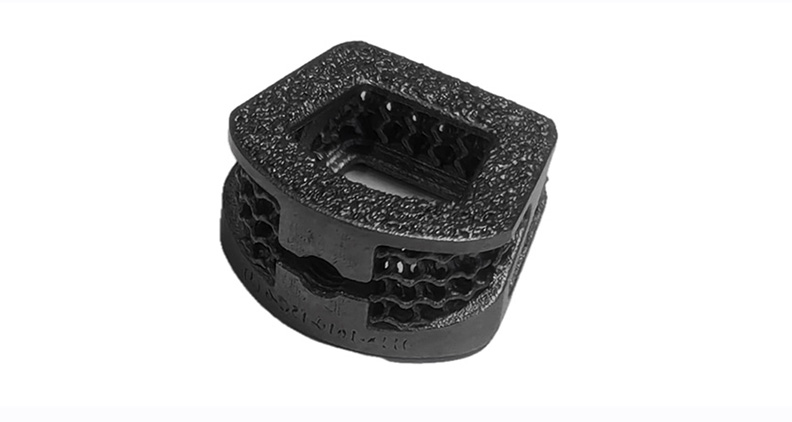
The company’s Flex-Z Cervical Cage, which received FDA 510(k) clearance in March, is manufactured with 3D-printed porous titanium and designed with an internal Z-shaped architecture that provides controlled cushioning and maintains the structural integrity needed for effective fusion. Its internal geometry, achieved with 3D printing, delivers ultra-low stiffness that closely matches the mechanical properties of cancellous bone and preserves the biological advantages of porous titanium.
Designing an implant with structural flexibility and porous architecture reflects a broader shift in orthopedic device design, according to SpinePoint, in which additive manufacturing is used to optimize a device’s biological and mechanical performance.
Medacta
Medacta’s MyImplant platform combines advanced imaging, digital planning and in-house 3D printing capabilities to create patient-specific solutions for challenging joint revision procedures. In April, the company expanded the platform from a focus on shoulder applications to include complex acetabular cup revisions involving extensive bone loss.
MyImplant analyzes preoperative CT scans of the unique anatomy of individual patients and generates a personalized implant design and surgical plan for each procedure. After surgeons assess the 3D model and implant fit, the design is used to build a monoblock titanium implant.
The 3D-printed implant is engineered to replicate the natural porosity of bone, creating a surface that promotes biological fixation and high intrinsic friction to achieve a precise scratch-fit with the surrounding anatomy and maximize initial stability and long-term osseointegration.
As the digitization of orthopedic surgery continues, Medacta shows that additive manufacturing can be combined with planning software, allowing surgeons to take on complex procedures with greater confidence and precision, factors that could lead to improved patient outcomes.
OSSTEC
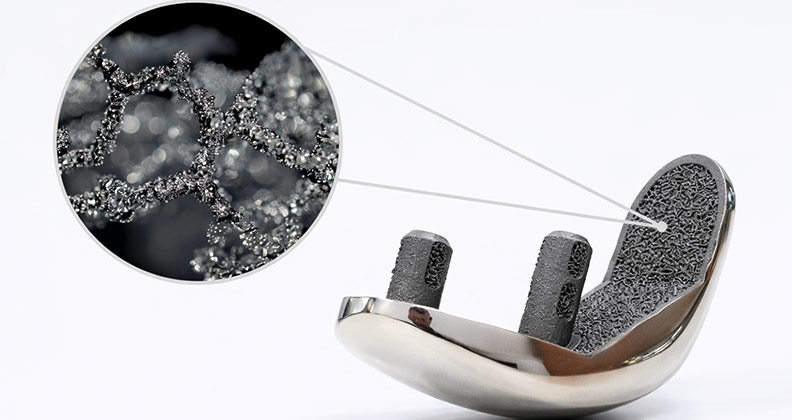
Cementless fixation in knee replacement surgery continues to gain momentum, and U.K.-based OSSTEC is rethinking the way implants designed for this application are made and perform. The company developed the ASCENT unicondylar knee arthroplasty system, which is made with a single-process additive manufacturing platform that combines a polished articulating surface and a porous fixation structure in a titanium implant.
Eliminating the interface between the articulating surface and porous bone-ingrowth structure removes a potential failure point while streamlining production and reducing supply chain complexity.
OSSTEC’s proprietary printing platform allows for biometric cementless fixation and shows how additive manufacturing can be used to build an entire load-bearing implant instead of printed components.
The company’s focus on cementless partial knees taps into a significant opportunity as a small percentage of the candidates for unicondylar replacements currently undergo the procedures. OSSTEC is staged for strategic growth and announced additional investor funding in February to back entry into the U.S. market.