

 Copy to clipboard
Orthopedic executives, supply chain leaders, design engineers and contract manufacturers convened at the University of Memphis last month for the ODT Forum, a one-day event packed with topical education and intimate networking opportunities.
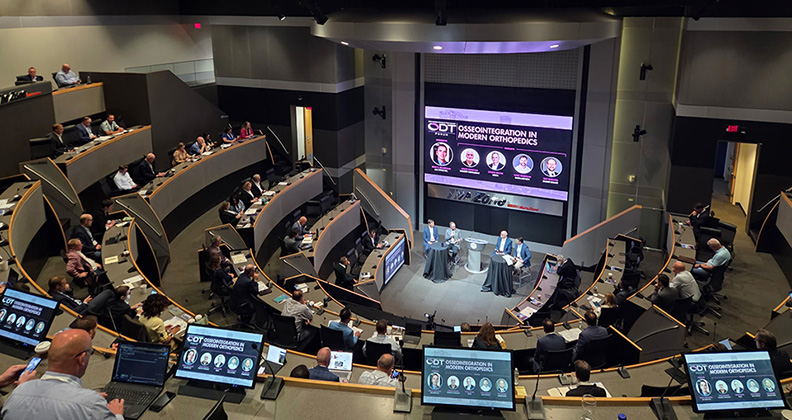
During dynamic panel discussions held in the FedEx Institute of Technology’s tiered amphitheater, industry experts covered key market trends and a range of important topics focused on optimizing device designs and manufacturing processes, building resilient supply chains and gaining a better understanding of all the moving parts involved in progressing napkin notes to successful commercialization.
What ASCs Want
Orthopedic cases of increasing complexity have been moving from inpatient hospitals to outpatient settings for years. The continued migration feels a bit like old news, but that doesn’t lessen the importance of one of the industry’s most important market forces.
Melanie Prevost, Associate Director of Marketing for ZBX ASC Solutions at Zimmer Biomet, said ASC ownership models impact surgeon interest in new surgical technologies, noting that surgeon-owners with financial skin in the game are interested in products that deliver value and quality patient outcomes. Zimmer Biomet took that factor into consideration during the development of the Identity Shoulder System, which contains all needed instrumentation in four streamlined trays.
“That has clear benefits for ASCs. Space is often limited, so minimizing storage requirements is critical,” Prevost said. “At the same time, fewer trays help reduce the burden on sterile processing departments, easing workflow and operational strain.”
It’s no secret that many orthopedic surgeons prefer to operate in ASCs, where they have greater control over clinical efficiencies, equipment use and patient-friendly care.
Patrick Toy, M.D., M.B.A., who practices at OrthoOne Sports and Orthopaedics in Tennessee and performs a diverse mix of procedures in his ASC, noted that many patients who undergo treatment in hospitals are discharged the same day, indicating that most cases will continue to shift to ASCs as equipment and workflow capabilities evolve.
Those aren’t the only factors that are driving orthopedic surgery’s outpatient future.
“A partner of mine used to say, ‘I don’t know what the question is, but the answer is money,’” Dr. Toy said, adding that many individuals face high deductibles and are responsible for a significant portion of their healthcare expenses.
“When procedures are performed in an ASC,” Dr. Toy said, “total costs are often 50% to 70% lower than in a hospital setting.”
Supply Chain Solutions
Orthopedic OEMs and contract manufacturers must shift from running reactive supply chains to taking a more proactive approach. Supply chain regionalization has become necessary for OEMs that want faster response times and strategic partnerships with suppliers.
Beyond that, according to Juan Mangual, Senior Director of Supply Chain at Smith+Nephew, is the need for greater resilience in the management and movement of materials and products.
“I know that sounds like a buzzword, but it’s actually a very practical discipline,” he said. “Building resilience into supply chains requires actively engaging with suppliers by understanding their processes, identifying bottlenecks and recognizing how your own purchasing patterns and capacity expectations impact their operations.”
Dual sourcing is also necessary, but requires a thoughtful, case-by-case approach. OEMs need to carefully consider the types of products they’re buying, the volume to which they can commit and how that business supports a sustainable and mutually beneficial supplier relationship.
“When you move beyond a transactional mindset and work with truly resilient supplier partners that are aligned with your goals and willing to problem-solve in collaborative ways, you see meaningful improvements,” Mangual said.
Improved Implant Designs
Numerous design and manufacturing techniques have been used to improve the osseointegration of load-bearing implants. Large joint applications require enough structural strength to handle physiological loads and porous architecture to promote fixation and bone in-growth.
“Before the advent of additive manufacturing, we were hamstrung by the processes available to create those porous structures,” said Trey Rodgers, Ph.D., Principal Engineer at Zimmer Biomet’s Advanced Technology Research Group. “Traditional methods limited the design and complexity of the lattice structure, and they often required additional steps to attach the porous layer to the base implant.”
Additive manufacturing has changed that dynamic, allowing engineers to build porous structures into the overall implant design. It’s also opened the door to improved designs for cementless options, which continue to gain adoption among joint replacement surgeons.
Mark Morrison, Ph.D., Research Director at Smith+Nephew, said cementless designs introduce additional complexity in post-print processing and surface architecture, and creating and validating the porous structures required for osseointegration adds steps and technical considerations to the development of cementless designs. Such systems have traditionally been costlier than cemented options, but additive manufacturing is changing that calculus.
“The cost gap between the two approaches is no longer as significant as it once was,” Dr. Morrison said.
He noted that most of Smith+Nephew’s implants are produced with conventional machining, and that additively manufactured devices represent a small percentage of the company’s portfolio. However, he has seen steady growth in additive manufacturing applications within the company and expects that trend to continue.
Cost and production inefficiencies are two of the biggest barriers to greater adoption of additive manufacturing, according to Dr. Morrison, who believes the technology should be reserved for applications that make the most financial and logistical sense.
“Certain additive processes are not well suited for high-volume production — hundreds of thousands of parts per year — so that naturally limits where the technology is economically viable,” he said. “There needs to be a clear value proposition. It doesn’t make sense to print everything, especially when many components can be produced more efficiently through conventional machining or other established manufacturing methods.”
Infection remains a significant complication of joint replacement surgery, and OEMs are pouring resources into development of implant coatings and materials with antimicrobial properties that mitigate the risks.
Dr. Rodgers called infection one of the most significant challenges in orthopedics that remains uniquely difficult to solve.
“The biological environment around an implant is particularly challenging,” he said. “There’s limited vascular access, and biofilm can form on the implant’s surface. Once that happens, it effectively shields bacteria from the immune system.”
Infection risk is one of the primary barriers to joint replacement surgery for patients who want to avoid the potential complication, even if the risk is low, and put off surgery until their mobility and quality of life deteriorates enough to make the decision for them.
“If we can meaningfully reduce infection risk, and I think this is closely tied to improvements in osseointegration and implant surfaces, we could potentially unlock a much broader patient population,” Dr. Rodgers said. “More patients would be willing to undergo surgery earlier in the disease progression.”
Dr. Rodgers believes personalized implants aren’t necessary for most knee replacement patients, whose anatomy falls within normal ranges covered by stock designs, and robotics can help improve the accuracy of most implant placements. He said patients who truly need personalized implants have severe bone loss, poor bone quality, have undergone complex revision surgery or have anatomy outliers that don’t fit standard implant sizing.
“From a practical standpoint, we already produce thousands of patient-specific devices each year,” he said. “The key question is whether patients actually need that level of customization to achieve a better outcome.”
He added that future implant designs could be built off population-based data that captures most anatomical variability and address fit more intelligently, without needing a bespoke solution for every patient.
Large joint reconstruction remains the biggest overall opportunity in terms of total market size. Chuck Hansford, Director of Advanced Development at Tecomet, called it one of the most competitive and complex spaces, combining high procedural volume with significant variability in patient anatomy and surgical approach.
However, Hansford sees other opportunities where OEMs should focus R&D efforts on moving forward. “If you look at the market from a growth-rate perspective rather than absolute dollars, extremities represent a major opportunity,” he said. “Shoulders, in particular, are likely the fastest-growing segment in percentage terms.”
That takeaway was one of the many lessons learned at a meeting that captured the pulse of orthopedic device development in one of the nation’s major orthopedic hubs. Our trips to Memphis to meet with industry leaders have always proved valuable. This time was no different.