

 Copy to clipboard
The OMTEC Excellence Awards celebrate advancements that are shaping the future of orthopedic manufacturing, device performance and patient care. Stryker, Carlsmed and THINK Surgical took home this year’s top honors and will be recognized during an awards ceremony at OMTEC 2026. Representatives from the winning companies will also discuss their innovative products and share the challenges they faced, the pivotal development decisions they made and the key lessons they realized in bringing groundbreaking technologies to market. Secure your spot at OMTEC to help celebrate their achievements and learn from their successes.
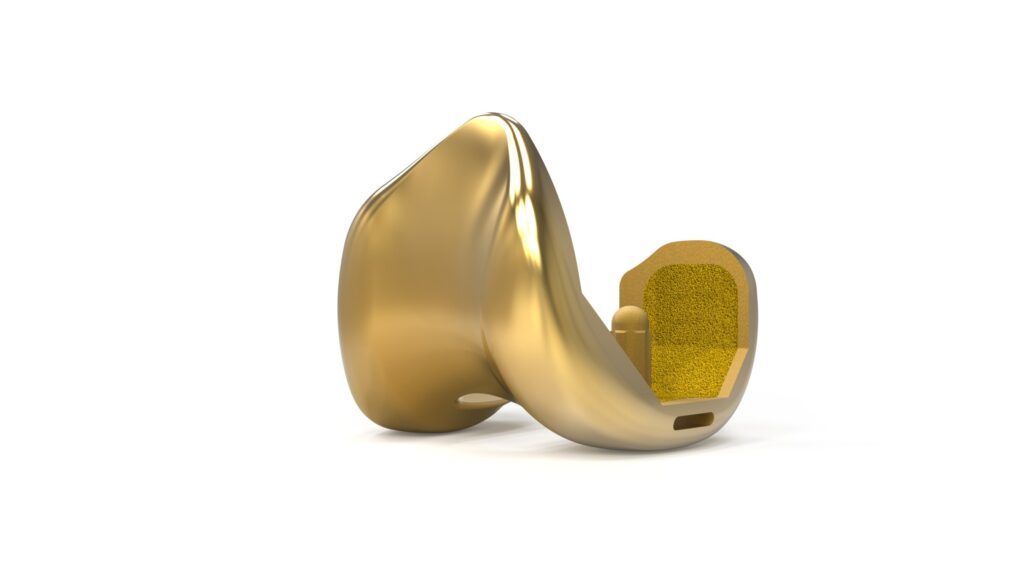
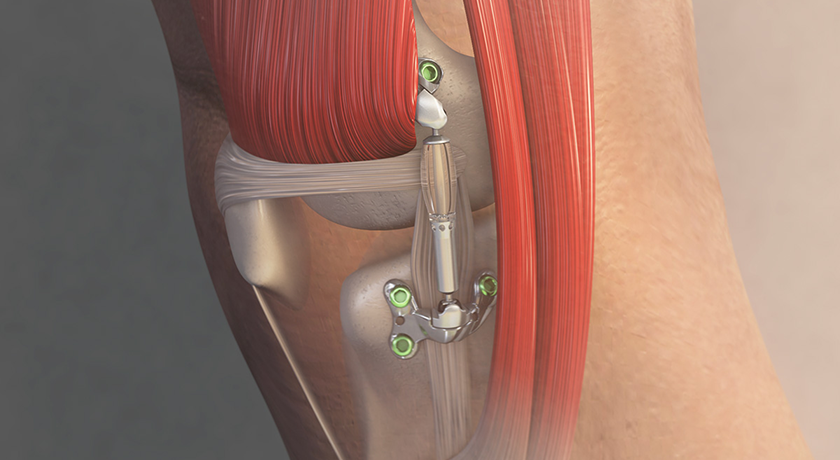
Triathlon Gold offers flexibility for both cemented and cementless workflows.
Stryker Adds to Its Knee Implant Design Legacy
Stryker earned an OMTEC Excellence Award for the development of Triathlon Gold, the company’s most recent innovation in 3D-printed implants. Triathlon Gold, which is an option for patients with metal sensitivity or bone cement allergy concerns, combines the company’s Triathlon CR design with an additively manufactured titanium substrate and biocompatible titanium nitride coating. It’s Stryker’s first additively manufactured femoral component and first product with a titanium-nitride coating.
“Globally, there is a range of patients who present with metal sensitivity or cement allergy concerns, and our surgeon customers asked us to develop an option for these patients,” said Lewis Mullen, Director of Advanced Technology at Stryker.
The company continues to build on the 20-year legacy of the Triathlon portfolio and its strong clinical evidence for stability, survivorship, and patient satisfaction.
“By leveraging new 3D printing capabilities, we can manufacture a titanium-based implant that’s coated with titanium nitride and streamline the production, which opens up design flexibility in the future,” said Lisa Kloes, Vice President and General Manager of Stryker’s knee business.
Clinical Versatility. Triathlon Gold’s femoral component features a titanium nitride surface and Triathlon cementless technology that’s designed to deliver fixation and long-term durability with scratch resistance that’s claimed to be superior to competitive surfaces.
Triathlon Gold can be implanted with cemented or cementless fixation, a level of flexibility that matches current trends in joint replacement care.
“Being able to select a cemented or cementless option allows surgeons to use their preferred fixation method and workflow,” Mullen said. “A surgeon often determines during surgery whether cemented or cementless fixation is right for the patient, so this dual indication provides efficient intraoperative decision-making.”
The new implant has the same geometry as the legacy Triathlon femur, meaning it fits into existing surgical workflows. Its medial-stabilized insert is intended to enhance knee stability and create a natural kinematic feel for patients through the joint’s full range of motion — two important clinical goals for joint replacement surgeons.
Stryker notes that titanium nitride-coated hip and knee implants have been used for patients with metal sensitivity concerns since the 1990s, with retrieval analyses and clinical cohort studies showing reliable performance.
Preclinical studies report that Stryker’s titanium nitride coating provides high surface hardness and scratch resistance. Under laboratory tribology testing, coated implant surfaces have shown lower coefficients of friction, decreased polyethylene wear, increased abrasive wear resistance and improved corrosion resistance compared to uncoated substrates.
According to Stryker, Triathlon Gold also demonstrates wear rates equivalent to the established Triathlon cobalt-chrome femoral component, supporting excellent wear performance.
Additive Advantages. The fact that the Triathlon Gold femoral knee component is additively manufactured from Ti6Al4V as a single piece means the titanium porous structure is an integral part of the substrate and therefore doesn’t require complex secondary treatments such as plasma spraying or beading.
“A key achievement was successfully building the titanium substrate and meeting dimensional requirements for such a geometrically complex component,” Mullen said. “Fortunately, we had access to a range of additive manufacturing techniques, which enabled us to identify the optimal method for the task.”
Stryker has been working with additive manufacturing technologies since the early 2000s and has developed significant expertise regarding how to best implement the technologies to print devices, at scale, with a focus on quality and product performance.
“As we continue to expand and realize new implant features and benefits through the use of additive manufacturing, we are constantly building on previous lessons learned to ensure we stay at the leading edge,” Mullen said.
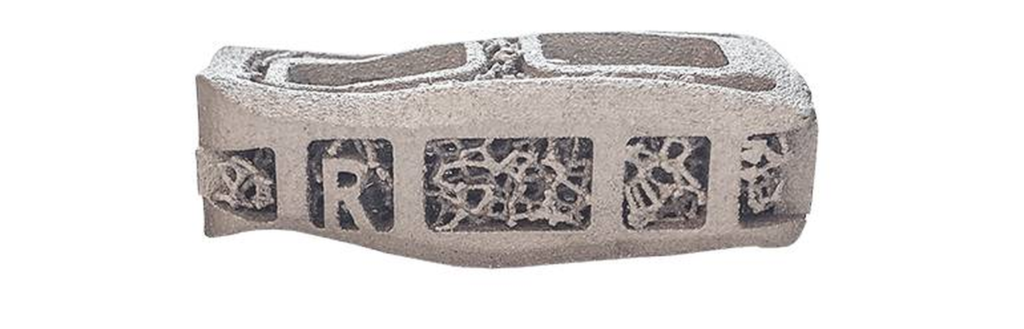
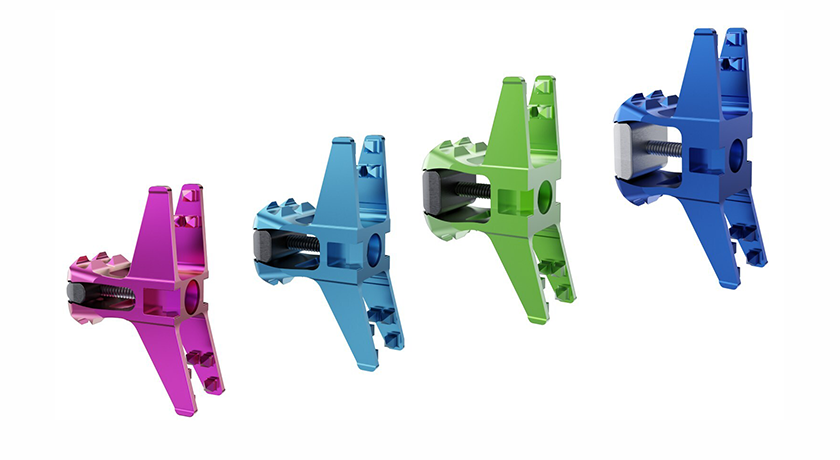
Carlsmed’s aprevo implants aim to improve the standard of care for spine fusions.
Carlsmed Leads the Way in Personalized Spine Care
Personalized surgical solutions continue to advance patient care, and Carlsmed is bringing that movement to the spine market. The company’s aprevo technology platform combines patient-specific surgical planning and 3D-printed implants with a data-driven feedback loop to improve the outcomes of lumbar and cervical fusions.
Those advancements make Carlsmed a worthy recipient of an OMTEC Excellence Award.
“Integrating digital preoperative planning and postoperative intelligence is reshaping how spine surgery is performed,” said Mike Cordonnier, Co-Founder, Chairman and CEO of Carlsmed. “We shift key decision-making to the preoperative phase, using data to create a highly predictable intraoperative experience.”
Individual Optimization. With the aprevo platform, Carlsmed creates a virtual model of the patient’s specific pathology and develops an optimal 3D surgical plan and personalized implants tailored to that individual. The plan and implant designs are sent to the surgeon for review and approval, after which Carlsmed manufactures patient-specific devices and single-use instruments for the procedure.
Following surgery, Carlsmed collects postoperative data through its aprevo intelligence platform, capturing what was planned, what occurred intraoperatively and how well implant alignment is maintained over time. This data is continuously fed back into the intelligence platform, creating a feedback loop that increases the precision of surgery across patient populations and individual surgeons.
Adoption of the aprevo platform has been strong; the company grew its surgeon user base by nearly 70% last year.
“The technology is powerful, but we keep the interface simple by clearly showing alignment targets, how the devices will achieve them, and the specifications of what will be used in the procedure,” Cordonnier said.
Carlsmed’s digital production system enables the company to manufacture, sterilize, and deliver patient-specific devices directly to the operating room within six business days. There are no trays to reprocess or excess inventory to store. Everything arrives sterile and ready for use.
“After surgery, surgeons access a dashboard of their cases, giving them confidence as they transition from traditional spine surgery to a more data-driven, digital approach,” Cordonnier said. “That’s where the real magic happens, and what drives optimal outcomes.”
Payment Carveouts. One of the key advantages of the aprevo technology is the ability to leverage clinical data to support regulatory and reimbursement pathways. Carlsmed submitted that data to FDA and received Breakthrough Device designation, initially for aprevo’s lumbar application. The designations allowed Carlsmed to secure a New Technology Add-on Payment (NTAP) for Medicare patients.
The company continued to collect clinical data, leading to the securement of permanent DRG reimbursement, which provides incremental Medicare payments for the lumbar fusion technology and gives hospitals a financial incentive to adopt the device that can improve outcomes while lowering the overall cost of care.
After seeing significant traction for aprevo’s lumbar spine application, Carlsmed expanded the technology into the cervical spine. Cordonnier said it’s difficult to achieve positive outcomes in anterior cervical discectomy and fusion in patients with osteoporosis, osteopenia, or generally soft bone, which leads to higher revision rates that affect roughly one-third of cervical fusion patients.
Carlsmed developed the aprevo cervical technology specifically for this population.
“Unlike traditional wedge-shaped interbody devices that often require removal of endplate bone for placement, our implants are designed to be wider and extend out to the uncinate joints,” Cordonnier said. “That design creates a larger surface area, which is great for contacting soft bone.”
Carlsmed also collects postoperative data for the aprevo cervical technology and provides that feedback to surgeons, giving them the insight and confidence to scale adoption.
The company also received Breakthrough Device designation from FDA and an NTAP for the aprevo cervical platform. That’s key, Cordonnier said, because of Carlsmed’s focus on treating inpatient populations, which typically consist of older individuals with osteoporotic bone.
Widespread Benefits. Cordonnier considers Carlsmed the only pure-play personalized surgery company creating value across the surgical ecosystem. For patients, that means more predictable procedures. For surgeons, it shifts decision-making to the preoperative phase and makes the intraoperative experience more consistent and controlled. And for payors, it means reducing costly revisions by improving the efficiency and outcomes of primary procedures.
“We’re growing rapidly and still in the early stages, and we’re very excited about what the future holds for personalized surgery,” Cordonnier said. “Our commitment to innovation will continue as we expand access to data-driven solutions.”
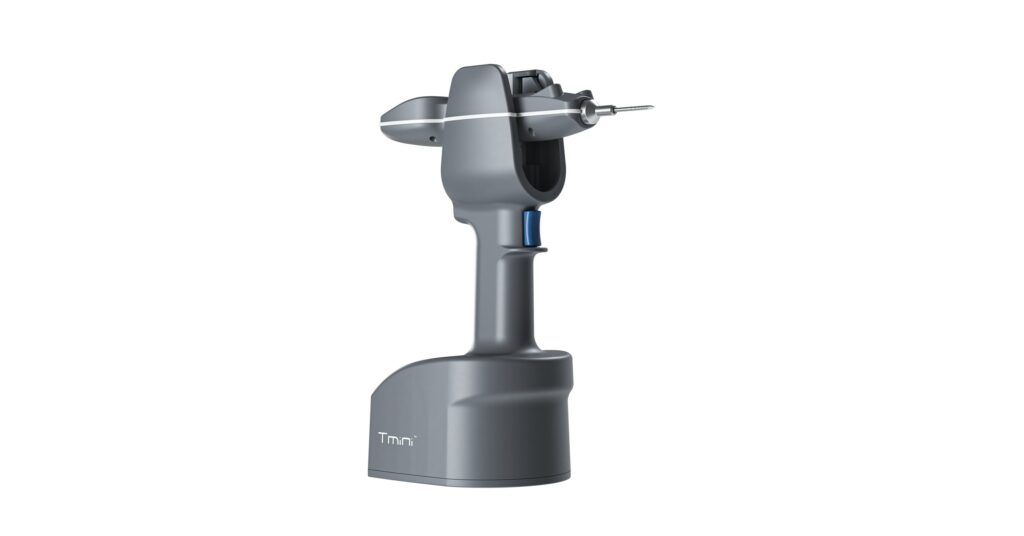
Demand is strong for handheld robotic technology compatible with several knee replacement implants.
THINK Surgical Wins Big on Open Platform Robotic Surgery
THINK Surgical bet on the big-time potential of the TMINI System, a CT-based, implant-agnostic handheld robot, and the open platform robotic surgery concept. The investment is paying off in a huge way and is worthy of one of this year’s OMTEC Excellence Awards.
“We are changing the paradigm in joint replacement robotics and disrupting the business model of closed platform systems,” said Jon Gibson, Vice President of Marketing at THINK Surgical. “Open platform is the future of the market, and we believe this disruption benefits surgeons, hospitals, ASCs, and patients.”
Surgeon Buy-In. The penetration of robotics in the U.S. joint replacement market sits at only around 20%. THINK Surgical developed TMINI with the belief that introducing an open handheld platform that aligns with existing surgical workflows would increase adoption among surgeons.
In late 2024, THINK Surgical conducted a double-blinded survey of 250 high-volume orthopedic surgeons who represent about 5% of the U.S. joint procedure volume. When asked if their implant of choice matched their robot of choice, only 47% said that it did.
“That means many surgeons are being forced to make a clinical compromise — choosing between their preferred implant and their preferred technology,” Gibson said. “We’re meeting surgeons where they are in the adoption of robotic technology.”
For the 80% of surgeons not currently using robotics, TMINI acts as a smart robotic tool that places pins, while allowing them to continue using the manual instruments they’re comfortable with. For surgeons who use TMINI, the jump to robotic-assisted surgery isn’t that big a leap. Plus, Gibson points out that surgeons who are in many ways highly specialized craftsmen want to maintain the tactile control that handheld devices provide.
“The system eliminates overhead line-of-sight constraints and creates a small form factor that still delivers the accuracy surgeons expect,” Gibson said. “So far, early user feedback suggests it’s easy to use.”
THINK Surgical has also challenged the closed-platform business model, another apparent barrier to widespread surgeon adoption.
“It’s a bold stance, but we believe the closed model is neither scalable nor sustainable,” Gibson said. “If you look at the market, the only company that has really succeeded with a closed platform is Stryker, largely due to its first-mover advantage and strong technology. Other players have entered the space but haven’t meaningfully gained share — and in some cases have lost ground or remained flat.”
From a hospital perspective, Gibson noted, it’s difficult to justify purchasing multiple robotic systems to accommodate surgeons’ various implant preferences. Doing so increases capital and service costs, and vendor complexity.
Because TMINI is not tied to a single implant system, THINK Surgical supports a broad library of implant designs. If a surgeon is seeing increased adoption of a particular implant, but also wants to use robotics, they now have a pathway to do both.
Two years ago, THINK Surgical inked a limited distribution agreement with Zimmer Biomet, which added a customized TMINI to its robotic surgery portfolio. In February of this year, THINK Surgical received FDA 510(k) clearance for the TMINI’s compatibility with Stryker’s Triathlon Knee System, expanding the system’s applications to nine compatible implant options.
“Zimmer Biomet would not have partnered with us unless they saw clear value in what we were offering,” Gibson said, “and I think the relationship created value on both sides.”
He believes the deal validated a real need in the market for handheld robotics, even for a company that already has a flagship platform like ROSA.
“In that sense, offering an additional option — smaller, more nimble robotics alongside more established platforms — expanded their portfolio and gave them greater flexibility in addressing different surgeon preferences,” Gibson said.
Gibson said adding Stryker’s implants through an independent development pathway was another validating moment. “For a long time, the industry narrative to surgeons has been that an open platform simply isn’t feasible — that we’ll never get enough implant companies to participate, the regulatory hurdles are too high, and the model won’t work at scale. In fact, we’ve shown that it can be done.”
Room for Growth. THINK Surgical has a proprietary method that’s been cleared through the regulatory process, allowing the company to integrate implants into the TMINI platform without requiring direct partnership with implant manufacturers. From a strategic standpoint, the company can move toward adding implant systems with the highest market share.
“Today, between our existing implant partners, distribution agreement with Zimmer Biomet and adding Stryker’s implants, we cover approximately 65% of the U.S. joint replacement market share,” Gibson said. “That’s very compelling for our surgeon customers.”
Disrupting the joint replacement market requires more than strong technology, according to Gibson, who cited three key factors: a compelling robotic platform, a high-quality implant system, and a differentiated business model.
“That last piece is what breaks the closed-system structure we’ve historically seen in orthopedics,” Gibson said. “We’re starting to see pressure build in that direction. Hospitals are entering contracts that involve multiple robots, which are unsustainable. The market is being forced to rethink how robotic systems are deployed and integrated.”
THINK Surgical wants to add more major implant brands onto the TMINI platform, with the goal of reaching approximately 95% market coverage by the end of the year. Once the company reaches that level, its focus will shift from proving the feasibility of open platform robotic surgery to driving greater adoption among surgeons by educating the market, scaling the model, and accelerating commercial traction.
Over the long-term, the company will continue to evolve the TMINI platform by adding features and potentially expanding indications.
“But the strategic inflection point is now,” Gibson said. “By the end of this year, we expect to be in a position where we are directly challenging the closed-platform paradigm.”