

 Copy to clipboard
There’s real value in understanding supply chain dynamics and the ways digitization of the processes will impact orthopedic forecasting.
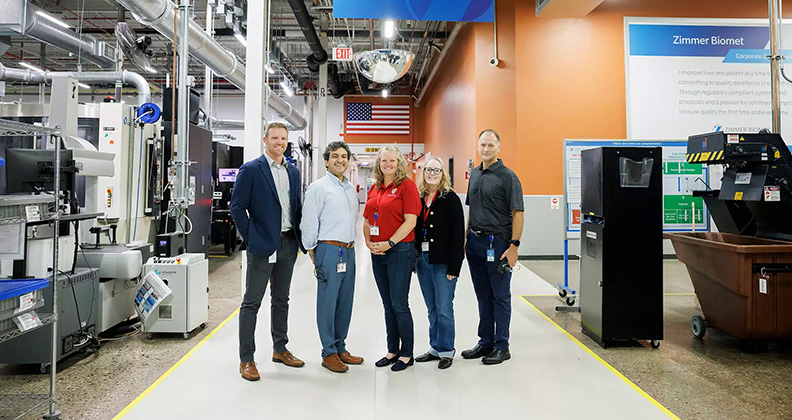
“At its core, digitization improves visibility into the supply chain in terms of knowing where products are, what condition they’re in and how they’re moving,” said Amrou Awaysheh, Ph.D., One America Foundation Endowed Chair and Professor of Operations and Supply Chain Management at the Kelly School of Business at Indiana University. He’s part of Indiana University’s new partnership with Zimmer Biomet that aims to optimize orthopedic supply chain performance and operational efficiencies.
The sheer amount of available data could create a new level of demand planning for companies that are positioned to leverage the computing power of AI. “With data-driven insights, organizations can now perform predictive analysis to anticipate production needs, optimize inventory management and ensure that the right materials are available exactly when and where they’re needed,” Dr. Awaysheh said.
AI doesn’t deliver perfect results across every scenario, but it doesn’t need to, according to Dr. Awaysheh, who said many orthopedic companies are achieving 95% to 99% accuracy across a range of use cases with the technology.
“When I ask companies about their current forecasting accuracy, the answer is often in the 60% range,” he said. “That’s barely better than a coin flip. If adding a few more data inputs and AI analysis can push the accuracy into the mid-90s, the value is substantial.”
Instead of waiting until AI is 100% accurate, the more practical approach is leveraging what’s achievable today and moving forward with improvements on current demand planning standards by focusing on data availability and, as importantly, data sharing.
If an OEM tells a contract manufacturer that it needs 300 units of one implant size and 200 of another, the contract manufacturer passes those requirements to its own suppliers, requesting the necessary raw materials to meet the OEM’s order. On the surface, the process seems straightforward.
The challenge lies in how those numbers are generated and communicated across the supply chain. Small fluctuations or inaccuracies in demand signals become increasingly exaggerated as they move downstream.
“If the OEM can access more granular, real-time data closer to the point of use, such as actual hospital demand or procedure-level insights, it can significantly improve forecast accuracy,” Dr. Awaysheh said. “That improved signal has a ripple effect. The contract manufacturer receives more precise requirements, and suppliers can plan production with greater confidence.”
AI and advanced digital tools are helping OEMs and contract manufacturers access and analyze data closer to its source.
“By reducing reliance on estimates and eliminating artificial buffers, companies can align more closely with true demand and improve demand planning, reduce waste and stabilize the entire supply chain,” Dr. Awaysheh said.
Before capitalizing on the power of AI to optimize demand planning, you must first understand all levels of your supply chain. It’s a basic idea and concept, but Dr. Awaysheh believes many orthopedic companies don’t fully understand where products are, how components move or how different parts of the system interact. Establishing that visibility is the critical starting point.
The next step involves gathering and structuring data to assess the accuracy of current demand planning and evaluate the performance over time. It’s a process that has required significant manual effort, but AI-enabled tools now allow for faster and more accurate data analysis that’s much less labor-intensive.
With that foundation in place, companies can begin building systems that support predictive supply chain management and use AI-driven data analysis to not just understand past performance, but to anticipate what will happen next. That forward-looking view is part of Dr. Awaysheh’s work at Indiana University.
“Orthopedic companies that want to better understand or apply AI’s capabilities can benefit from engaging with academic and research institutions to accelerate adoption and implementation,” he said.
Dr. Awaysheh is bullish on AI’s potential to transform how products move from manufacturing facilities to the frontlines of care. In the near- to mid-term, he said, the goal is to eliminate unnecessary slack and waste across the supply chain. By tightening operations and minimizing overproduction, companies can significantly lower costs across the system.
Ultimately, Dr. Awaysheh said that being able to achieve a level of responsiveness that delivers the right implant at the right time for the right patient, without surplus or inefficiencies, is increasingly within reach.
“The future state will be far more streamlined,” he said. “One product, precisely matched to the patient’s clinical need, delivered exactly when and where it’s required.”
Achieving that level of alignment will not only improve supply chain performance but also create a more cost-effective and patient-centered healthcare system.