

 Copy to clipboard
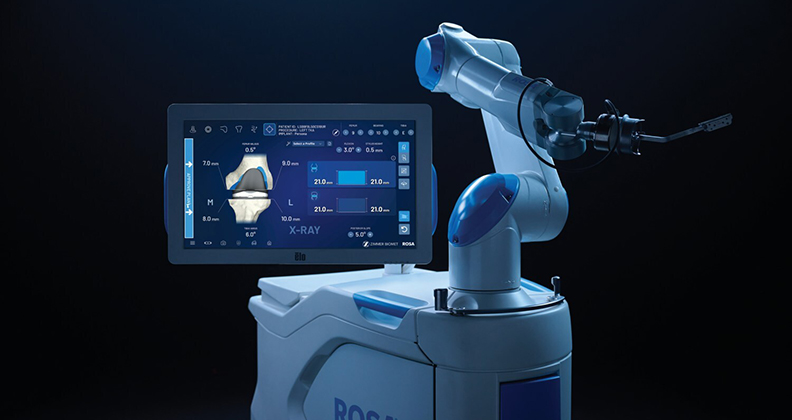
The knee replacement market is split between surgeons who’ve never used a robot and those who swear by the benefits of robotic assistance. Zimmer Biomet wanted to serve the interests of both groups with the introduction of ROSA Knee with OptimiZe, an enhanced version of the ROSA Knee System that offers a more customized approach for surgeons.
“This is one of our largest releases on ROSA,” said Shaun Braun, Senior Vice President and Chief Information and Technology Officer at Zimmer Biomet. “It’s the result of a tremendous amount of R&D and a lot of direct surgeon feedback.”
Zimmer Biomet’s R&D teams embedded themselves in operating rooms, observed real procedures and collaborated with surgeons to understand how robotic systems help them perform better and more efficient surgeries. “In a way, the product almost named itself,” Braun said. “When we stepped back and looked at what really mattered, everything was about optimizing the surgeon experience.”
With more than 2,000 ROSA systems deployed globally, Zimmer Biomet had access to a tremendous amount of real-world feedback. “We’ve got an incredible install base,” Braun said, “and we took those learnings to shape what we believe is going to be a big step forward for robotic knee surgery.”
ROSA Knee with OptimiZe — dubbed “ROSA 1.5” by Zimmer Biomet — features ActiveTrack, which allows surgeons to make guided bone cuts without placing registration pins. The efficiency gains have been significant, according to Braun, who said surgeons have realized a 46% reduction in surgical times.
At the core of ROSA 1.5’s upgrade are smart algorithms that create surgical plans that align with a surgeon’s knee-balancing preferences.
Surgeons who prefer functional alignment use customizable profiles that automatically position the implant and balance the knee based on the patient’s anatomy. For surgeons who prefer kinematic alignment, ROSA 1.5 offers the industry’s only automated kinematic alignment feature, which resurfaces the knee and restores its pre-arthritic position and native joint lines.
Through Zimmer Biomet’s mymobility app, surgeons gain an understanding of a patient’s unique clinical needs before procedures based on their activity level, lifestyle, step counts and readiness for surgery, all of which feed directly into the kinematic planning.
ROSA 1.5 then integrates with ZB Edge Analytics, which connects intraoperative data with patient mobility and outcome metrics from the mymobility app to close the feedback loop. Surgeons see how their intraoperative decisions affect the recoveries of individual patients in near real time.
“We’ve been in the data game for a long time and that allows us to give surgeons the power to harness data and drive more science into a procedure that is still, in many ways, an art,” Braun said. “When our Persona Personalized Knee implant is combined with ROSA 1.5, we’re seeing up to 95% patient satisfaction in knee replacement outcomes. Our goal is to keep driving that number higher and higher.”
Streamlined Shoulder Replacement
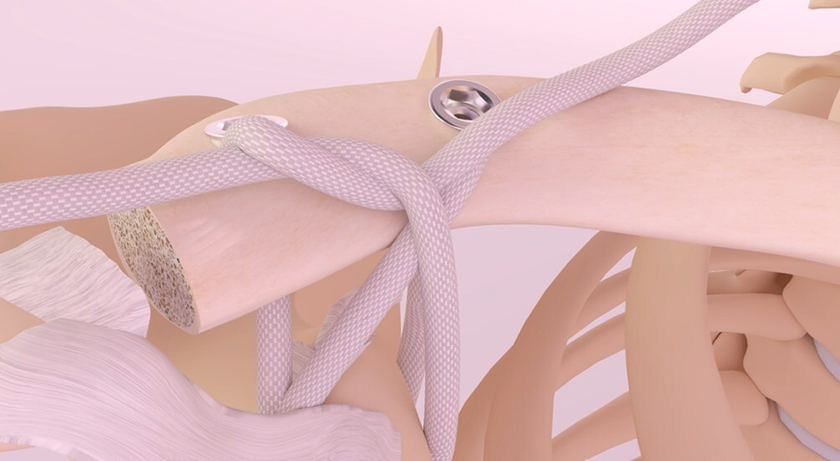
Enovis has built a strong track record with its AltiVate reverse shoulder platform, but the company saw an opportunity to expand the system’s applications with AltiVate Reverse Glenoid (ARG), a modular system designed for the variability of patient anatomy.
“Being able to address complex indications, especially revision surgeries and cases with severe bone loss, is what really drove ARG’s development,” said Bryan Monroe, Senior Vice President of Global Research and Development at Enovis.
The modular design of the ARG system allows for a variety of configurations to match complex shoulder anatomies. Surgeons can choose between wedge or thicker base plates and different screw options, ranging from 6.5 mm to 8.0 mm, for revision cases or patients with poor bone quality.
“That modularity offers surgeons a unique ability to mix and match where they want screws and where they want pegs,” Monroe said. “It also allows the base plate to be positioned optimally to address areas of bone loss or to achieve the best peripheral fixation, while still maintaining a center locking screw.”
When the ARG’s design shifted to a modular platform, the center locking screw had to be separated from the base plate, raising new design challenges.
“We didn’t want to create a big chunk of metal in the middle of the system that would take up a lot of bone,” Monroe said. “Our team spent a lot of time focusing on the boss design, thinking about how minimal it could be while still working in primary surgeries and providing enough support for revision cases or situations with poor bone stock.”
Enovis produced an effective balance through extensive iterative testing during cadaver labs with surgeon designers. “We think we found the sweet spot,” Monroe said. “There’s enough structure to achieve needed fixation without taking up or replacing unnecessary bone. We like to be bone-sparing in everything we do, and this approach does that.”
By separating the base plate from the fixation elements, ARG expands the range of treatment options and enables more precise customization in complex cases. “Going modular opened up possibilities in terms of design and the types of bones and bone morphologies surgeons can address,” Monroe said.
Enovis also focused on baking simplicity into ARG’s modular design because, as Monroe said, optionality can be a double-edged sword for surgeons. “More options often mean more instruments, more steps and more opportunities for error,” he added.
To address that concern, ARG was designed to be intuitive and streamlined. Monroe highlights the ease of preparation for the base plate, including the reamers and other instruments, as a key advantage.
Despite Enovis’ success in the shoulder replacement market, Monroe said the company is striving to keep up with the pace of innovation.
“The shoulder market is moving faster than hips and knees,” he added. “We’re building on our clinical success, adding to the story, but not radically reinventing the system. It’s all about thoughtful growth that enhances what’s already working.”