Copy to clipboard
The biggest players in Big Ortho drive industry trends and set high bars for revenue growth, but it’s often the early-stage companies that introduce fresh ideas and innovative devices to a crowded market.
Here are a few startups we’ll be monitoring in the months ahead as they push what’s possible in regenerative medicine, joint preservation, trauma care, AI imaging, personalized spine surgery and partial knees.
ReGelTec
The company is tackling chronic low back pain caused by degenerative disc disease with the HYDRAFIL System, which uses a percutaneous, needle-delivered hydrogel implant to augment the nucleus of a degenerated disc without the need for open surgery. When the hydrogel implant solidifies in the disc, it distributes the load and strain felt in that intervertebral segment to improve function and reduce pain signaling to the brain.
According to clinical data, patients treated with HYDRAFIL experienced rapid and sustained improvements in pain and function. In a multi-site study, patients saw disability scores improve by more than 80% and pain scores drop by more than 70% over 12 months.
ReGelTec received a CE Mark for HYDRAFIL in 2025 and has launched a 225-patient FDA IDE trial in North America, paving the way for the company to develop a minimally invasive alternative to fusion and disc replacement for the 10 million Americans who suffer from degenerative disc disease, a clear unmet clinical need.
BlueOcean Global
Limb reconstruction is a complex condition to address in patients with vascular issues, diabetes, infection, past trauma and chronic non-healing wounds. BlueOcean Global’s Excelsior External Fixation System lets surgeons construct and modify circular frames to correct deformities and perform limb reconstruction and salvaging procedures with a single, modular platform.
The system’s circular fixator manages skeletal stability and soft tissue protection and is guided by BlueOcean Global’s FASTR (Fixator Assisted Soft Tissue Repair) framework, which integrates offloading and soft tissue support directly into the frame construct rather than treating wounds as a secondary problem.
The modular system allows surgeons to build and modify circular frames to create an integrated approach in complex limb salvage when bone stability and soft tissue issues must be addressed at the same time.
BlueOcean Global received FDA clearance for the Excelsior External Fixation System in January and is planning a phased rollout of the device throughout 2026.
See All AI
The company’s intraoperative imaging with an AI-driven platform converts standard 2D fluoroscopy images into navigable 3D models without the need for CT, MRI or intraoperative imaging systems.
See All AI’s software uses two fluoroscopic images to generate high-resolution models with 1mm slices across multiple planes. The system integrates with minimally invasive surgical workflows and does not require registration markers or direct line-of-sight between the patient and the system’s Track All visible light camera, factors that improve case set-up times and promote intraoperative flexibility.
The company’s technology is designed to be used with the estimated 150,000 fluoroscopy systems already deployed worldwide. The company is led by Eric Major, who previously ran K2M, and Gene Gregerson, inventor of the O-Arm. In May 2025, See All AI closed a $33 million funding round to accelerate the imaging platform’s development and commercialization.
OSSTEC
U.K.-based OSSTEC is advancing cementless partial knee implants with a single-process 3D-printing approach that integrates a porous fixation surface and an articulating surface into one build.
By printing the entire implant as a single structure, OSSTEC reduces manufacturing complexity and eliminates the fault line between the printing surface and the underlying substrate to create a biomimetic fixation surface that encourages bone ingrowth.
The company’s cementless unicompartmental knee design is supported by surgeon feedback and the extensive background that OSSTEC’s team has with the uni knee surgical technique, which the company believes is underused by joint replacement surgeons.
Up to half of knee replacement patients are candidates for partial knees, but only about 10% undergo the procedure. OSSTEC believes it can close that gap and has raised funding to complete first cases with its cementless partial knee implant in the U.K. and gain regulatory approval for the design in the U.S.
Phoenix Kinetics
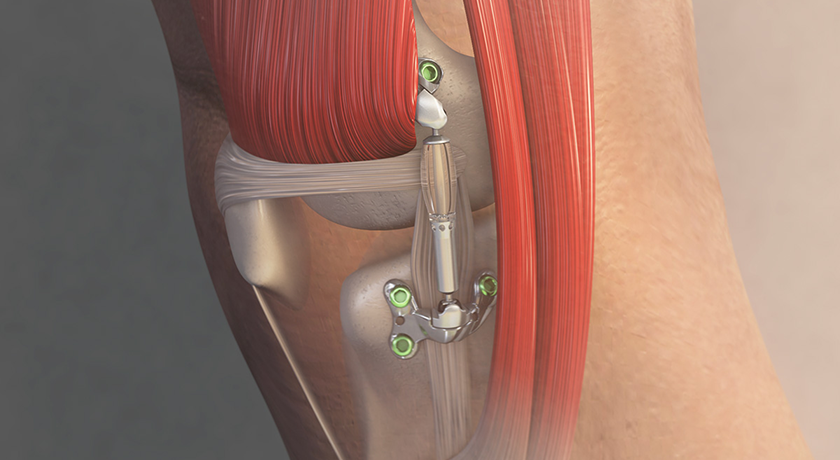
The company’s NUsurface Meniscus Implant is a non-fixated, load-sharing device made from a polycarbonate-urethane composite that’s engineered to protect articular cartilage and restore the primary mechanical function of the meniscus.
Unlike traditional meniscus repairs or resections, NUsurface is designed to restore the load distribution of the meniscus without bone tunnels or fixation. Its peripheral geometry and material properties provide stability through “controlled compliance” by accommodating translation and rotation under dynamic loads.
With 15 years of safety data and FDA Breakthrough Device Designation, Phoenix Kinetics is preparing a De Novo submission and building the commercial infrastructure for U.S. launch to target the treatment of active adults between 45 and 65 years who have limited treatment options today.
Nivalon Medical
Nivalon Medical has produced what it calls the first fully patient-specific, motion-preserving and metal-free spinal implant. EvoFlex’s AI-driven design and 3D-printed production eliminates metal-related issues such as corrosion, ion release, stiffness mismatch and imaging artifacts.
EvoFlex combines zirconia-toughened alumina ceramic endplates that behave like bone with a flexible elastomeric that preserves the spine’s natural motion. It’s digitally designed directly from the CT scans of individual patients to match their specific anatomy and natural biomechanics.
The implant’s performance is backed by biomechanical, biological and anatomical testing that has validated its motion profiles, strength and osseointegration potential.
Nivalon is planning to launch first-in-human procedures involving EvoFlex and FDA PMA clinical trials this year.
Forma Medical
Forma Medical’s OptimalMTP system enables surgeons to perform metatarsophalangeal (MTP) joint fusions with low-profile plates delivered through minimally invasive incisions, leading to faster recoveries for patients and fewer wound complications.
More than 650 patients have been treated with OptimalMTP, and Forma Medical is focused on accelerated adoption by selling surgeons on the benefits of using a standard plate-and-screw construct that can be placed with minimally invasive surgical techniques.
The company has also expanded into Lapidus procedures with the OptimalTMT system, which applies the same minimally invasive techniques to bunion correction, creating an alternative fixation device to open plating procedures.
What other companies are rethinking what’s possible in orthopedic care? Reach out to let us know.