

 Copy to clipboard
The spine market comprises hundreds of companies seeking to bring new technologies to market that enhance fusion, add motion preservation or improve the way procedures are performed. Avid BONEZONE readers responded to our article, 10 Compelling Companies We Want to Connect with at NASS, by highlighting additional new technologies that are entering the market.
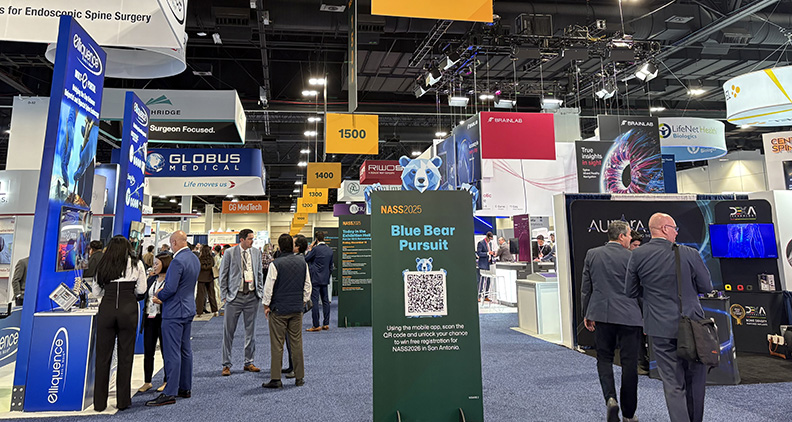
Here are eight additional companies that piqued our interest while attending the Musculoskeletal New Ventures Conference and NASS Annual Meeting earlier this month.
Enabling Technology
Robotics and navigation are transforming the landscape in spine. The market’s largest companies are building ecosystems of technology to capture data, inform and participate in more of the patients’ journey. Startups and small companies believe there is space to compete with more advanced and efficient technology.
See All AI, founded by Eric Major, who previously led K2M, and Gene Gregerson, inventor of the O-Arm, had a significant presence at NASS. The company plans to leverage the more than 150,000 fluoroscopy units already in use worldwide by transforming standard 2D C-arm fluoroscopic images into navigable 3D models with 1mm cross-sectional slices, eliminating the need for preoperative CTs, MRIs or other scans, as well as additional intraoperative imaging systems.
See All AI’s system requires no direct line of sight between the patient and the company’s proprietary visible light camera, providing surgeons with 3D visualization of the patient’s internal anatomy without the need to create an open exposure.
8i Robotics showcased updates to its system, which includes three robotic arms that work in concert. The arms feature an optical imaging head with an integrated digital microscope, as well as left and right surgical arms that enable a high torque screwdriver and ultrasonic bone cutting.
8i Robotics claims its next-generation robot will offer comprehensive surgical site coverage and extend beyond traditional pedicle screw placement. The company is partnering with Implanet to bring the robot to market in Europe. 8i Robotics was founded by Victor Yang, M.D., the inventor of the 7D Surgical System, which he sold to Orthofix.
Metamorphosis is developing navigation technology that does not rely on external trackers and reference bodies. Its system generates 3D navigation information from a single 2D x-ray image, which the company believes will enhance the reliability of the technology.
Metamorphosis also showcased its autonomous robot for pedicle drilling and sought to satisfy surgeons’ appetite for robotic independence. The company said its overall goal is to explore how artificial intelligence, imaging and augmented reality can advance surgical navigation.
Captiva Spine announced that its WatchTower Spine Navigation System received FDA 510(k) clearance for new 21cm and 31cm Flat-Panel C-Arm Image Calibrators and AI-assisted 2D-to-3D image registration. WatchTower transforms standard C-arm fluoroscopy into real-time 3D navigation, eliminating the need for an intraoperative CT. The system now supports the latest square-detector C-arms that deliver sharper, lower-dose images. WatchTower is a compact system designed by Remex to meet the needs of the ASC market.
Fusion Focused
Implant and orthobiologic companies aim to help patients achieve spinal fusion more quickly. The industry is heavily focused on the material and design of devices and bone grafts to meet this clinical need.
Cerapedics received FDA premarket approval of PearlMatrix P-15 Peptide Enhanced Bone Graft and began treating patients with the Class III drug/device combination product earlier this year. PearlMatrix is indicated for single-level transforaminal lumbar interbody fusion in adult patients with degenerative disc disease and is claimed to be the first and only bone growth accelerator proven to accelerate lumbar fusion.
Full results from Cerapedics’ ASPIRE study are expected to be published in the coming weeks. However, the company noted that the study found patients achieved statistically superior fusion speed at 24 months, with more than twice as many patients fused at six months compared to those who received a local autograft.
NanoHive Medical plans to expand into patient-specific implants and smart sensors, aiming to capitalize on the growing importance of personalized devices. NanoHive secured the exclusive sublicense of DirectSync Surgical’s piezoelectric implantable sensor technology for spinal fusion and has since confirmed with FDA that the technology will go through the De Novo pathway.
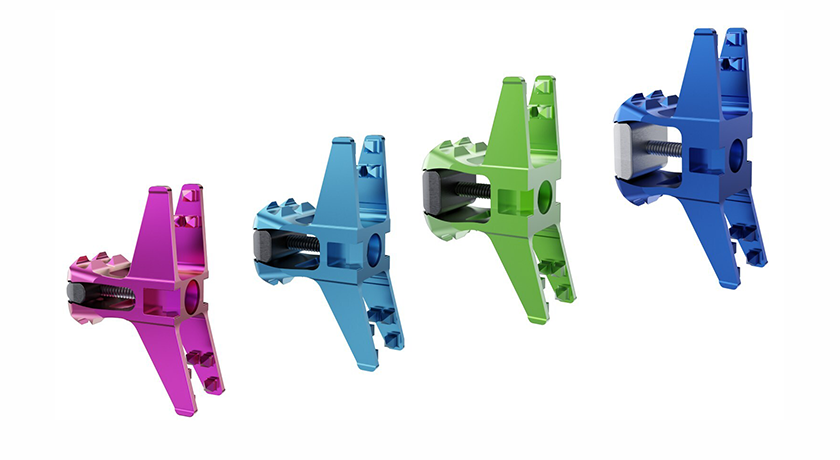
NanoHive is exploring how remote monitoring/data collection sensor technology can be housed in the company’s spinal interbody device. The company also commercializes the Hive Soft Titanium portfolio of 3D-printed spinal interbody fusion devices and plans to continue to expand that portfolio.
Unmet Clinical Needs
The spine market is not as mature as orthopedic segments, such as knee replacement and hip replacement. Unmet clinical needs remain, including advancing motion preservation devices to capture a wider patient population, enhancing devices to decrease spinal column deterioration over time and addressing issues with adhesion prevention and wound closure.
Synergy Spine Solutions seeks to advance cervical artificial disc replacement. The company’s Synergy implant is reportedly the first disc to restore both alignment and balance while preserving natural physiologic motion in the spine. The disc’s design has titanium-on-polyethylene articulation with a unique mobile center of rotation. The polythene core also incorporates varying degrees of lordotic correction to preserve or reconstruct sagittal alignment.
The Synergy Disc is available in multiple OUS markets, including Australia and Europe, and according to the company, has been implanted more than 5,000 times with no device-related complications. Synergy Spine Solutions is participating in two FDA-approved clinical trials that are fully enrolled.
Fziomed, which is focused on postsurgical adhesion prevention, was granted FDA De Novo classification for its Oxiplex gel in July and began commercialization in the U.S. in November. Oxiplex is indicated for reducing postoperative leg pain and neurological symptoms in adult patients undergoing lumbar spine procedures. It’s the only FDA-authorized intraoperative gel specifically designed for this indication.
Oxiplex is an absorbable, clear, viscoelastic gel that is applied to tissues and surrounding anatomy during surgery immediately prior to closure, acting as a temporary physical barrier between adjacent tissues. The gel has been sold outside the U.S. since 2002 and has been used in more than 1 million spine procedures worldwide. Fziomed submitted Level 1 clinical evidence from multiple U.S. randomized clinical trials, along with international post-marketing studies, to demonstrate the product’s safety profile and clinical benefit.