Copy to clipboard
Augmented reality (AR) systems give surgeons 3D visualization of patient anatomy in real time and directly in their line of sight, enabling more accurate implant placement, minimally invasive surgeries and safer navigation.
Christopher Morley, M.D., President of Medivis, believes the technology is pushing surgery into a new era of advanced computing. Earlier this year, Medivis received FDA 510(k) clearance for its Spine Navigation platform, which uses AR and artificial intelligence (AI) to deliver “holographic navigation” to minimally invasive spine procedures.
“Surgeons can ‘see the invisible,’ unlocking previously inaccessible visual information that enhances both precision and efficiency,” Dr. Morley said.
But while AR is enjoying wider adoption, it’s far from reaching its full potential. Dr. Morley said a lack of market awareness is the greatest barrier to the streamlined navigation technologies becoming standard practice in today’s operating rooms.
“Many surgeons still view these technologies as futuristic, without realizing that they are already proven, FDA-cleared and actively improving patient outcomes,” he said.
Focused on the Spine
Surgical Theater is one of a burgeoning class of medtech companies that are using AR in combination with other navigation modalities. The company has developed XR, or eXperiential Reality, for use in orthopedic, spinal and cranial surgeries.
Erik Bruskotter, Vice President of U.S. Sales at Surgical Theater, defines XR as a combination of AR and virtual reality. He said the technology allows surgeons to load a patient’s images into a platform to explain their specific spinal issues in a dynamic way and outline how they plan to fix them.
“When you show a patient their anatomical images in clinic, that’s obviously done in a virtual reality space,” Bruskotter said. Surgeons can also use the virtual reality images to plot out surgeries before using the technology in the O.R. to follow through on the plan.
SyncAR Spine, the company’s O.R. platform, uses these same images during spinal surgery, where they are projected over the operative field. Bruskotter explained that XR technology can deliver multiple anatomical views simultaneously, allowing surgeons to perform a more informed surgery.
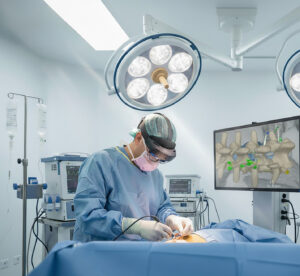
Dr. Poulter utilizing the nextgen SyncAR Spine for a minimally invasive TLIF
In October, Surgical Theater gained FDA 510(k) clearance for SyncAR Spine, the next-generation release of its spine platform. This clearance expands the system’s capabilities with advanced XR tools powered by AI algorithms.
When integrated with Medtronic’s StealthStation navigation, SyncAR Spine incorporates AI-driven vertebra segmentation, advanced decompression planning and segmental fusion to keep preoperative models aligned with intraoperative CT scans. Surgeons can track bone removal in real time with voxel-level drill tracking and bring MRI data and pathology into the O.R. for the first time.
Instead of having to reference an MRI monitor, Surgical Theater’s technology projects the information directly into the surgical field, allowing surgeons to see nerves, vessels and bone in real time. The planning and navigation software prevents surgeons from having to “hunt” for a certain amount of bone that needs to be removed or for the location of a spinal tumor because they can locate specific anatomy in real time. This allows surgeons to avoid clinical pitfalls in the O.R., saving time and costs.
The technology helps surgeons make more informed decisions.
“Surgeons could plan the case beforehand and understand what anatomy they should avoid or target,” said Bruskotter, who added that anatomy tracked by the technology is viewed as a reference point during surgery, and that the platform is designed to act as a visual guide.
“As AR improves and we bring in additional modalities like ultrasound to merge with it, we may be able to track more anatomy in real time, but right now we think of it as more of a general location finder,” Bruskotter said.
Surgical Theater’s XR technology is designed to fit within and build efficiencies into a surgeon’s original workflow.
“We’re not trying to be disruptive or ask surgeons to perform procedures differently,” he said. “We want to make sure that we’re seamlessly integrating additional technology so that surgeons can use it very simply.”
Bruskotter noted that AR is beginning to gain traction beyond orthopedics in cranial surgery and other healthcare markets. “Its adoption is increasing and as we are able to bring improved visualization into the surgical field, procedures become much more streamlined and efficient,” he said.
Medivis’ Spine Navigation platform takes patient-specific 3D data and superimposes it directly onto the operative field, allowing surgeons to plan and execute procedures with spatial awareness.
Through a proprietary spatial targeting interface, Spine Navigation visualizes trajectories and guides screw navigation with sub-millimetric accuracy while AI-based hand and instrument tracking supports natural interaction with data in 3D space.
By merging real-time 3D visualization with precise spatial guidance, surgeons can operate with greater confidence and accuracy, which supports improved patient outcomes, Dr. Morley said.
Medivis designed its Spine Navigation platform to integrate seamlessly into existing workflows, ensuring spine surgeons can maintain their high standards of care while providing patients with personalized surgical plans.
“Early data shows that implant placement can be completed 19% faster with the Medivis system compared to standard navigation, with similar expected gains relative to robotic-assisted surgeries,” said Osamah Choudhry, M.D., Medivis CEO. “The intuitive workflow enables 2D screw planning, 3D trajectory validation and real-time holographic navigation in a single, streamlined system.”
Medivis’ combination of spatial targeting with hybrid instrument tracking allows surgeons to work more efficiently and reduce operating time, radiation exposure and complications.
The Spinal Navigation platform’s AI-powered hand, eye and instrument tracking features allow surgeons to interact with medical images to move, expand, rotate and crop visual data. This functionality works in real time, allowing surgeons to visualize screw placement trajectories as they navigate, Dr. Morley said.
“By prioritizing high-quality visuals, seamless integration and intuitive design, our platform becomes a natural extension of the surgeon’s workflow and expertise,” he added. “Surgeons across specialties consistently highlight AR-based visualization and real-time interaction as the most transformative features. Clinicians value the ability to quickly pull, render and register holographic medical imaging data, enabling precise planning, optimal surgical corridors and minimal disruption to healthy tissue.”
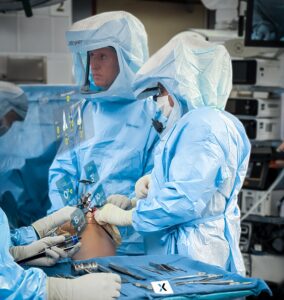
Dr. Safa Kassab performs the first U.S. surgery with Pixee Medical’s Knee+ NexSight system.
Procedural Versatility
Pixee Medical’s Knee+ NexSight AR platform provides real-time navigation of bony resections through smart glasses and specialized instrumentation designed to provide surgeons with sub-degree and sub-millimeter accuracy for component placement. Knee+ NexSight achieves implant positioning with robotic-like precision and enhances surgical efficiency. It provides surgical navigation without the need for percutaneous pins or an intramedullary rod.
“The system was designed to seamlessly integrate into existing surgical workflows, and no preoperative imaging is required,” said Josh Hagel, Vice President of U.S. Sales at Pixee Medical. “Registration is fast, with no disposables or external cameras. The learning curve is low and time neutrality to standard instrumentation is achievable.”
Hagel highlighted features like real-time intraoperative guidance, simplified surgical workflows and the ability to project bony landmark registration points directly onto patient anatomy as being some of the most valuable benefits of AR use during surgery.
“We believe it’s the next wave of orthopedic enabling technologies,” said Hagel, who added that navigation and robotics will need to become smaller, implant-agnostic, easier to use and more cost-effective for adoption to grow, especially as more cases move to ASCs.
“From a technological perspective, the functionality of AR has the potential to evolve well beyond that of traditional navigation and robotic systems to become the standard of care in orthopedics,” Hagel added.
Pixee Medical is currently focused on expanding into total shoulder and total hip replacement. The company’s goal is to be a one-stop shop for AR surgical navigation technology. “We believe we can accomplish this through a simple set of smart glasses and a small instrument tray.”
During computer-assisted surgery, surgeons traditionally face the challenge of needing to constantly shift their focus between the operative field and external display monitors showing navigation or planning data.
“This repeated change of visual focus introduces potential cognitive load and inefficiency, affecting overall precision and workflow,” said Gianluca Olgiati, Group Vice President of Marketing at Medacta. “AR revolutionizes this process by projecting patient-specific and real-time information directly into the surgeon’s field of view.”
Through immersive visualization, the surgeon can maintain constant attention on the surgical site while simultaneously accessing essential guidance data, such as anatomical landmarks, implant alignment and instrument trajectories.
In 2024, Medacta announced the completion of the first U.S. anatomic shoulder cases utilizing its NextAR surgical platform in combination with the Medacta Shoulder System. The company’s proprietary tracking platform provides real-time guidance for instruments to enable accurate implant positioning.
“By providing complete, precise and real-time intraoperative guidance during bone preparation and implant placement, NextAR enhances surgical accuracy while allowing for personalized adjustments based on each patient’s anatomy and biomechanics,” Olgiati said. “Clinical experience has already demonstrated improved precision of implant placement compared to conventional procedures.”
Olgiati described the integration of efficiency-driven changes into existing surgical workflows as one of the most complex challenges in modern surgery.
“The introduction of any new technology requires new routines and potential changes in behavior, but this needs to be done in ways that don’t compromise patient safety or surgical outcomes,” he said. “The way a technology integrates into existing procedures is as important as the technology itself.”
Like Surgical Theater’s surgical navigation tech, Medacta’s NextAR platform was designed around the principle of seamless integration into the ways surgeons currently work. The platform introduces real-time visualization through smart glasses without requiring additional equipment.
Medacta has integrated AR across all applications within its MySolutions Personalized Ecosystem, a digital platform that leverages individual patient data for a range of orthopedic procedures, including hip, knee, shoulder and spine surgeries.
“This strategic approach ensures that the same real-time, intuitive guidance is available to all surgeons, regardless of the procedures they perform,” Olgiati said.
According to Olgiati, interest in AR applications is growing among surgeons. However, the natural resistance to change and the inherent inertia that exists in surgical environments remain barriers to surgeon adoption. “Any new technology must therefore prove that it can integrate seamlessly into the O.R. without introducing additional risk,” he said.
Medacta is continuing to develop what it calls “sustainable innovation.” The company is generating clinical evidence to demonstrate the real benefits of AR and investing in education to make the adoption curve as smooth and as effortless as possible.
It’s that type of intuitive design and data-backed proof that will further the adoption of AR, the technology that is playing a significant role in advancing surgery’s high-tech future.