

Share on:
 Copy to clipboard
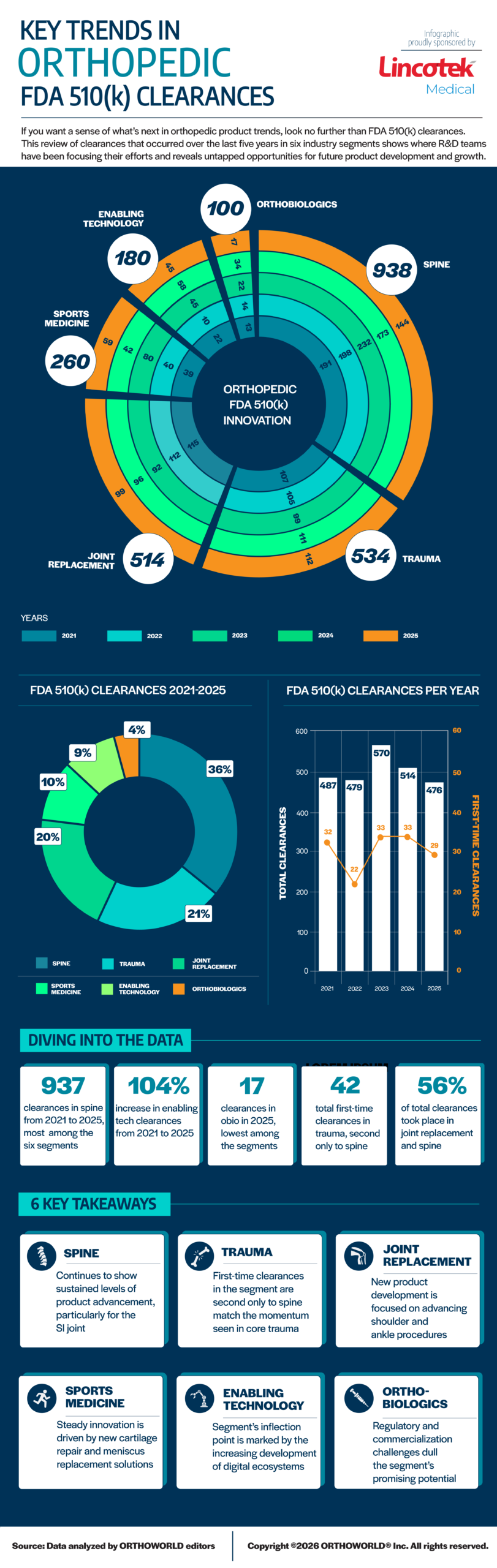
FDA has cleared more than 2,500 devices between 2021 and 2025, with spine outpacing the other major segments in orthopedics for the most clearances over the five-year span, driven in recent years by advances made by smaller companies like SI-BONE, Centinel Spine and Carlsmed. Their successes show that niche spine subsegments, such as SI fusion solutions, carry significant upside.
Product development efforts in sports medicine have evolved from new ways to treat torn ligaments to devices designed to preserve joint health and the damaging effects of osteoarthritis. Pediatrics has developed into a niche area of interest and growth potential.
What enabling technology lacks in numbers of clearances it more than makes up for in interest and investment throughout the industry. The biggest orthopedic players are developing integrated tech ecosystems to keep pace with the digitization of surgery and competition at the top of the spine and joint replacement markets. Navigation platforms, particularly augmented reality systems, and handheld robotic devices are serving as entry point to high-tech surgery by meeting surgeons where they are along the adoption curve.
Although orthobiologics continue to show tremendous promise in treating joint osteoarthritis, particularly in the knee, and could be introduced in combination with implants in spine and sports medicine procedures, a lack of clinical data backing the effectiveness of therapies and commercial challenges among some of the segment’s players have slowed widespread adoption of these therapies.
RELATED ARTICLES