


 Copy to clipboard
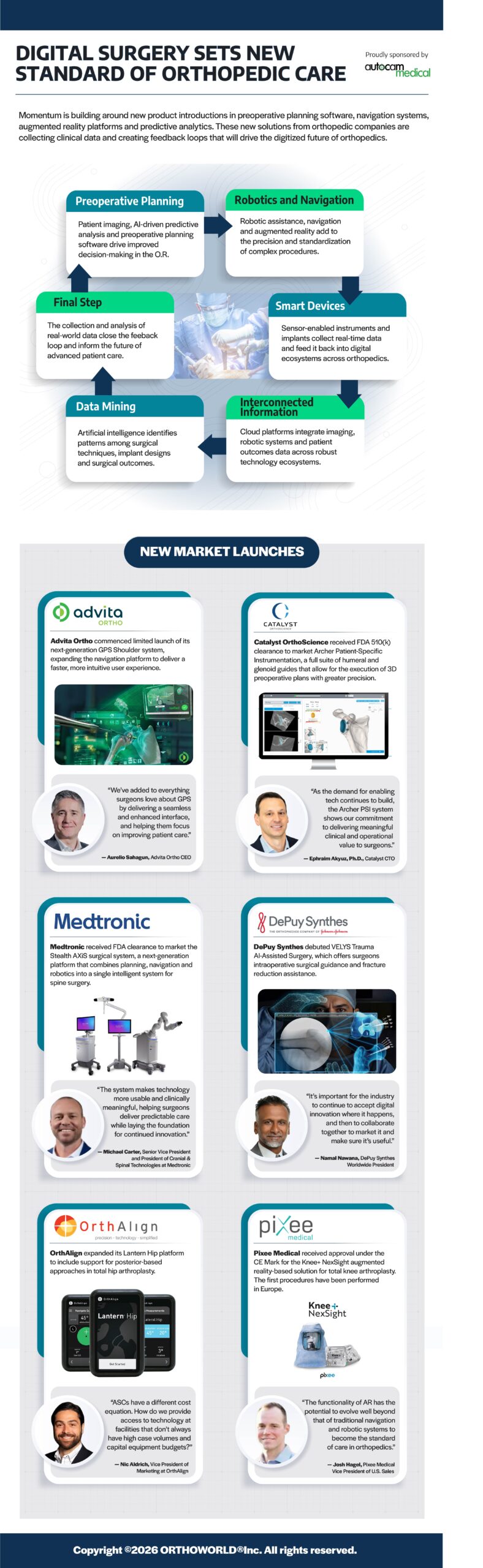
There’s no doubt that the digitization of orthopedic surgery is having a widespread impact on the future of patient care. The digital and mechanical aspects of procedures are merging to improve outcomes and inform the next generation of device design.
Beau Standish, Ph.D., Chief Enabling Technologies Officer at Orthofix, believes the real power of digital surgery lies in the data and navigation platforms that help guide surgeon decision-making.
At the Hospital for Special Surgery, orthopedic teams are using digital twins to create personalized virtual replicas of patients’ knees that can simulate real-world biomechanics. Their efforts are moving beyond one-size-fits-all surgical planning toward truly personalized care.
The digitization of surgery is also influencing the way companies view product development and their strategic outlook. This month’s infographic presents just a few examples:
- Advita Ortho is building an integrated technology platform powered by data, AI and machine learning.
- Catalyst Orthoscience is advancing 3D surgical planning and patient-specific device manufacturing.
- Medtronic’s Stealth AXiS Surgical System combines planning, navigation and robotics in a single intelligent system for spine surgery.
- DePuy Synthes wants to bring intraoperative guidance to fracture reduction surgery.
- OrthAlign delivers real-time guidance for accurate implant positioning and reliable leg length restoration in hip replacement surgery.
- Pixee Medical provides intraoperative navigation for knee replacements without time-consuming setup or instrument calibration.
Digital surgery has arrived and will continue to evolve exponentially in the years ahead to change the competitive landscape across the industry and force companies to development high-tech solutions to keep pace with the competition.
Infographic is proudly sponsored by Autocam Medical.