

 Copy to clipboard
Additive manufacturing has transformed how many medical devices are designed, produced, and tested. From patient-specific implants to lightweight surgical instruments, additive manufacturing enables unprecedented precision and customization. However, the rapid evolution of this technology has outpaced the ability of the manufacturing community to develop testing methods that accurately measure the true quality of additively manufactured components and devices.
Limitations of Traditional Testing
The FDA and the medical device industry have long relied on traditional verification coupons such as E8 tensile bars and validation methods designed to evaluate the outcomes of established production processes like casting and machining. While these approaches work well for conventional manufacturing, they fail to capture the complexities of additive manufacturing, where factors like laser power, scan strategy, and build orientation can significantly influence material behavior.
Experience has shown that E8 tensile bars are poor indicators of how additively manufactured implants actually perform. They overlook effects from thermal gradients, internal geometry, and the functionally porous or lattice structures common in additive manufacturing designs. As a result, these outdated standards are time-consuming, expensive, and provide limited insight into true part quality.
Additive manufacturing is pushing manufacturers and the FDA to move beyond the E8 status quo. In early 2024, a workshop was held to focus on developing representative build coupons, process monitoring, and geometry-specific test methods that better reflect how additively manufactured medical devices are made and perform. Improved testing is a critical step for ensuring reliable, high-quality devices as additive manufacturing becomes standard in orthopedics.
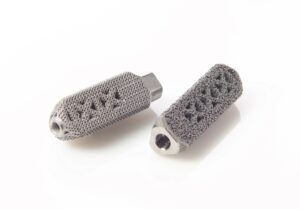
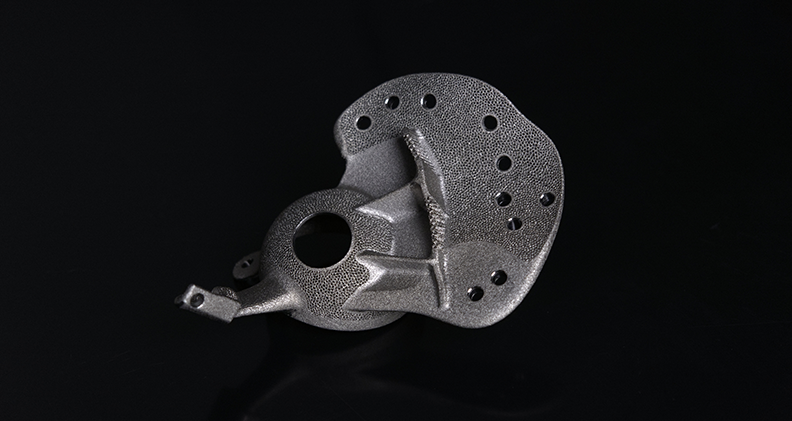
The intricate architecture of AM parts demands specialized testing protocols. Image courtesy of Cretex Medical.
Advancing Testing Strategies
Cretex Medical | rms, a leader in the field of additively-manufactured medical devices, has worked closely with the FDA, customers, and other industry members to develop better testing strategies and methods. Collaboratively, we’ve designed systems that allow companies to leverage coupons that more accurately represent their additively-manufactured products. These coupons follow defined guidelines but are tailored for each design.
To better measure quality, we employ new testing methods such as gravimetric relative density testing, compression testing, and profilometry-based indentation plastometry (PIP).
Gravimetric Testing
In additive manufacturing, gravimetric relative density testing is an effective tool for monitoring printer performance and process stability. These coupons are extremely sensitive to small process changes that cannot be detected by conventional coupons.
By measuring the mass of a representative coupon, we can evaluate its porosity. Small variations in porosity can indicate changes in factors such as laser power, beam quality, calibration, or scanner settings. Gravimetric testing helps verify that the device meets its intended specifications, including osseointegration and predicted mechanical properties.
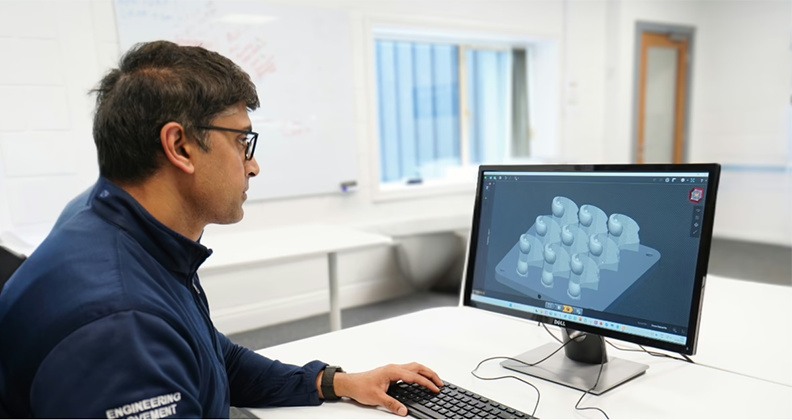
A properly designed gravimetric coupon utilizes the exact same scan and printer settings as the actual devices it represents, something nearly impossible to achieve with large test coupons like tensile bars.
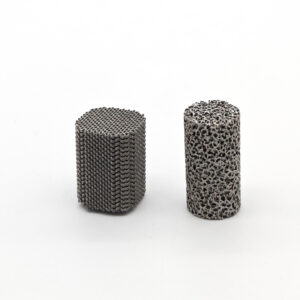
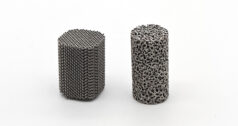
Gravimetric coupons mimic the exact printing conditions of real devices, providing more accurate validation than tensile bars. Image courtesy of Cretex Medical.
Compression Testing
Additively-manufactured devices can include lattice structures, gradient densities, or internal cavities designed to mimic natural bone or tissue. These functionally porous designs enable controlled mechanical properties and biological integration but also present new challenges for testing. Conventional methods are not always suitable for such unconventional structures.
Compression coupons can be designed to replicate the lattice or functionally porous architecture of customer parts, accurately capturing how complex 3D-printed forms respond to force. By adapting compression testing protocols to the unique characteristics of additively-manufactured parts, manufacturers can generate more reliable data about strength, elasticity, and failure points.
PIP Testing
PIP is an emerging test method used to evaluate the mechanical properties of metallic components produced through additive manufacturing. Unlike conventional hardness tests, PIP combines precise indentation with high-resolution surface profilometry to measure deformation depth and recovery, providing detailed insight into a material’s mechanical behavior.
When combined with finite element analysis modeling, PIP can determine the 2% offset yield strength, work-hardening rate, and ultimate tensile strength of a specimen. By offering nondestructive, microscale evaluation of additively manufactured materials, PIP testing supports improved process validation, part qualification, and greater confidence in the mechanical reliability of 3D-printed metal components without the need for destructive tensile specimens.
The size, preparation, and non-destructive nature of PIP testing also combine to significantly reduce testing costs.
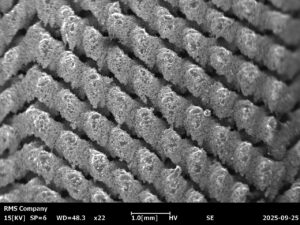
Additively-manufactured lattice structure captured via scanning electron microscopy (SEM). Image courtesy of Cretex Medical.
Improved Accuracy and Efficiency
The adoption of these new standards and processes has led to less time-consuming testing cycles for manufacturers and has reduced wasted material. Recent submissions to the FDA have also seen significantly shorter review times using this approach.
Applying advanced testing methods to advanced manufacturing processes saves customers time and money and increases confidence in the accuracy and utility of the testing results.
Of course, these methods won’t be the last advancements in the field. New and better testing technologies will be needed as orthopedic companies continue to push the boundaries of additive manufacturing’s capabilities. Emerging evaluation techniques such as industrial CT scanning and non-linear acoustical NDT (non-destructive testing) are already in development and show great promise for the future of additive manufacturing testing standards.
Your Trusted Partner in an Ever-Evolving Field
Cretex Medical | rms was one of the first medical device manufacturers to offer validated laser powder bed fusion (LPBF) products. Our years of experience and investment in industry-leading additive manufacturing technology allow us to design and produce components and devices of remarkable complexity.
Our experts are leaders in the field, working closely with regulators and industry partners to shape the AM standards of today and tomorrow.
When looking for a contract MDM to meet your additive manufacturing needs, you need a company with state-of-the-art technology and the capacity to scale with you as you grow. With Cretex Medical | rms, you also have a partner with the additive manufacturing expertise that’s needed to maximize efficiency, minimize costs, and guide your products safely to market.